

In brief:
- AI-powered voice agents are emerging as a powerful solution to rising ticket volumes, growing IT complexity, and ongoing shortages of qualified talent.
- AI voice agents overcome many limitations of traditional IT support automation like IVR systems and self-service portals – offering the ability to autonomously resolve common service issues through natural, human-like interactions.
- Voice agents can deliver specialized support for complex IT processes – and other customer care operations – while providing speed, scalability, and responsiveness previously unattainable for this level of problem-solving.
As technology ecosystems grow more complex and AI adoption accelerates, reliable IT support is becoming mission critical for business continuity. Yet, delivering fast, effective help desk service has become more challenging – and costly.
AI voice agents are emerging as a highly effective and cost-efficient solution – bringing an unprecedented ability to autonomously resolve the common issues that make up 70-85% of help desk calls (Naitive), while enabling human agents to focus on more complex and higher-level support.
The global help desk solutions market, currently valued at $1.73 billion, is expected to grow to $4.1 billion by 2035, according to Market Growth Reports. Organizations now handle more than 2.3 billion annual support tickets globally, with average ticket volumes growing 16% since the pandemic.
The growing need for support can be attributed to the widespread adoption of more technology platforms, proliferation of account types, and increasing security restrictions in the face of growing cyberattacks – all of which create more complexity at workplaces and hence, the need for reliable, scalable IT support.
This blog explains how AI-powered voice agents are emerging as a powerful solution to meet the demand for sophisticated help desk and customer care operations – exploring the technology’s benefits as well as service desk use cases across industries. We also illustrate how to implement AI voice agents effectively for your IT service desk, using Auxis’ internal implementation as a case study.
The rise of AI voice agents
Interactive voice response, or IVR, systems have long been used to receive and handle inbound voice call routing through menu‑based, touch‑tone, or voice prompts, helping alleviate pressure on help desk agents during busy hours and providing callers an immediate – if basic – response.
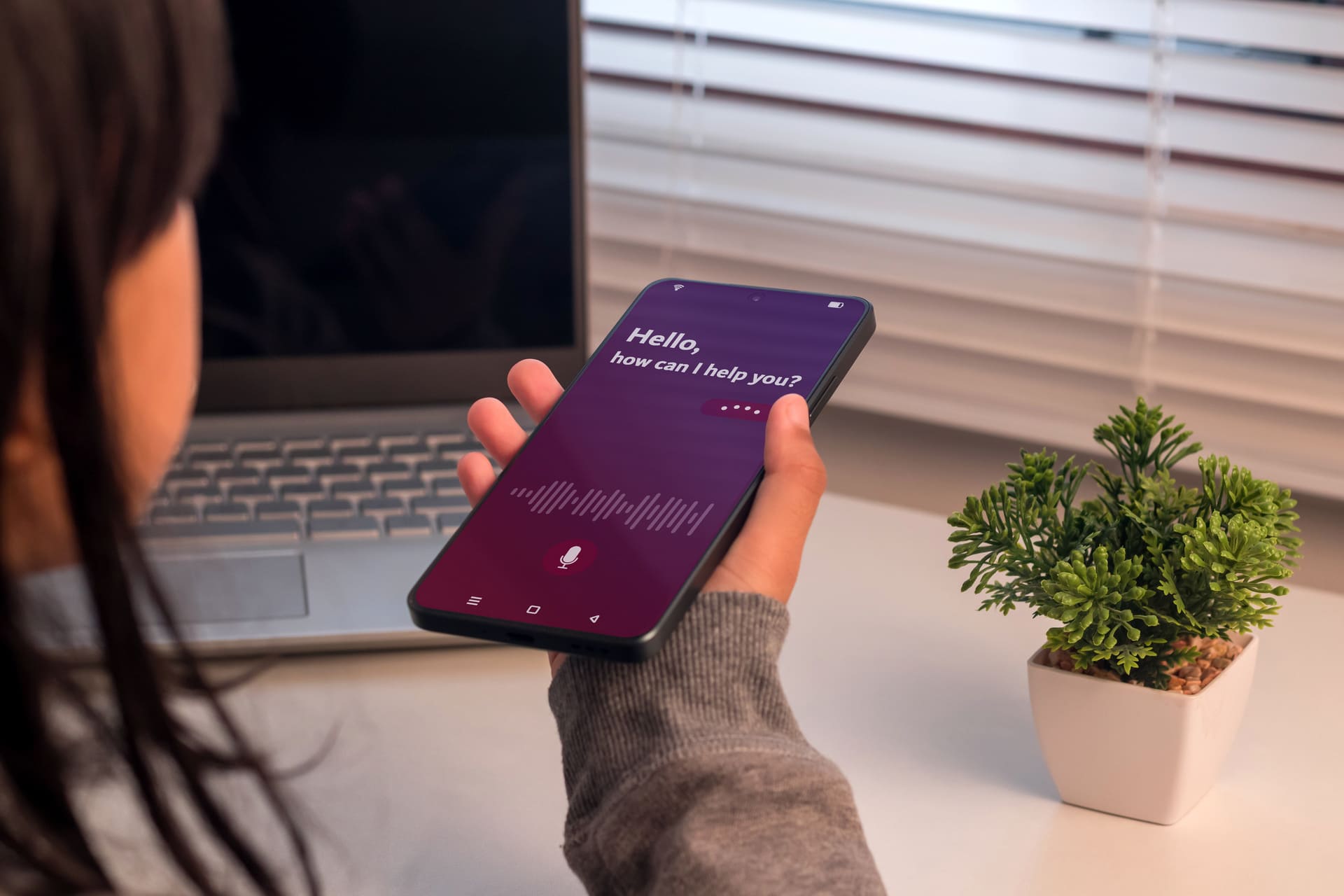
In recent years, IT support automation such as self-service portals and chatbots have also seen widespread adoption as businesses try to manage rising ticket volumes, improve responsiveness, and reduce pressure on help desk agents amid ongoing hiring and retention challenges.
Yet, such simple automations often fall short when faced by exceptions and complex, non‑standard issues – primarily due to a lack of self-intelligence that causes reliance on predefined rules and pre-recorded scripts. A Gartner survey found only 14% of customer service and support issues are fully resolved in self-service.
Enter AI-powered voice agents. Powered by next-gen AI solutions like Agentic AI and Generative AI, AI voice agents are ushering in a new era of autonomous, intelligent, and always-available personalized support.
Based on advanced natural language understanding (NLU), contextual reasoning, and real-time learning, AI voice agents can engage in fluid, context-aware interactions that can adapt in real time – making them capable of resolving complex support issues faster than ever before. This is making it possible to extend automation into scenarios that previously required human intervention, including troubleshooting multi-step issues like VPN or email access failures, unlocking accounts and resetting credentials in real time, and end‑to‑end ticket creation with intelligent escalation.
Key features and benefits of AI voice agents for IT support
AI voice agents have the potential to transform IT support – delivering specialized assistance for complex IT processes across industries, while also providing scale and speed that was previously unattainable for this level of problem-solving.
The technology is seeing rapid adoption across IT and customer service desks. The global AI voice agent market grew to $47.2 billion in 2025 – representing a 34% CAGR since 2022 – and is expected to reach $89 billion by 2028, AI Voice Research found. Growth is being fueled by accelerating enterprise adoption, with voice agent deployments increasing 340% in 2025 compared with the previous year.
Below we explore some key ways AI voice agents can enhance help desk capabilities and elevate user experience:
- Providing a true 24x7x365 front line for support. AI voice agents serve as the first point of contact for all inbound calls, extending Level 0 support beyond knowledge bases, chatbots, and self-service tools into a truly omnichannel, voice-driven experience with zero wait times.
- Delivering natural, human–like interactions. Advanced speech recognition and intent understanding allow smooth, conversational interactions with non-technical end users – such as restaurant staff troubleshooting POS systems or students calling university help desks – making support more intuitive and accessible.
- Resolving common issues autonomously. Voice agents can independently handle high-volume requests such as password resets and account lockouts, while also creating tickets for more complex issues and routing users to the appropriate support path. This ensures routine tasks are automated while human technicians retain complete control over complex escalations.
- Improving escalation experiences. AI voice agents can seamlessly transfer users to live agents with full contextual handoff, eliminating one of the most common frustrations in IT support: repeating the issue every time a ticket is transferred. Average handle time of calls improved by 42% compared to traditional IVR systems, AI Voice Research found.
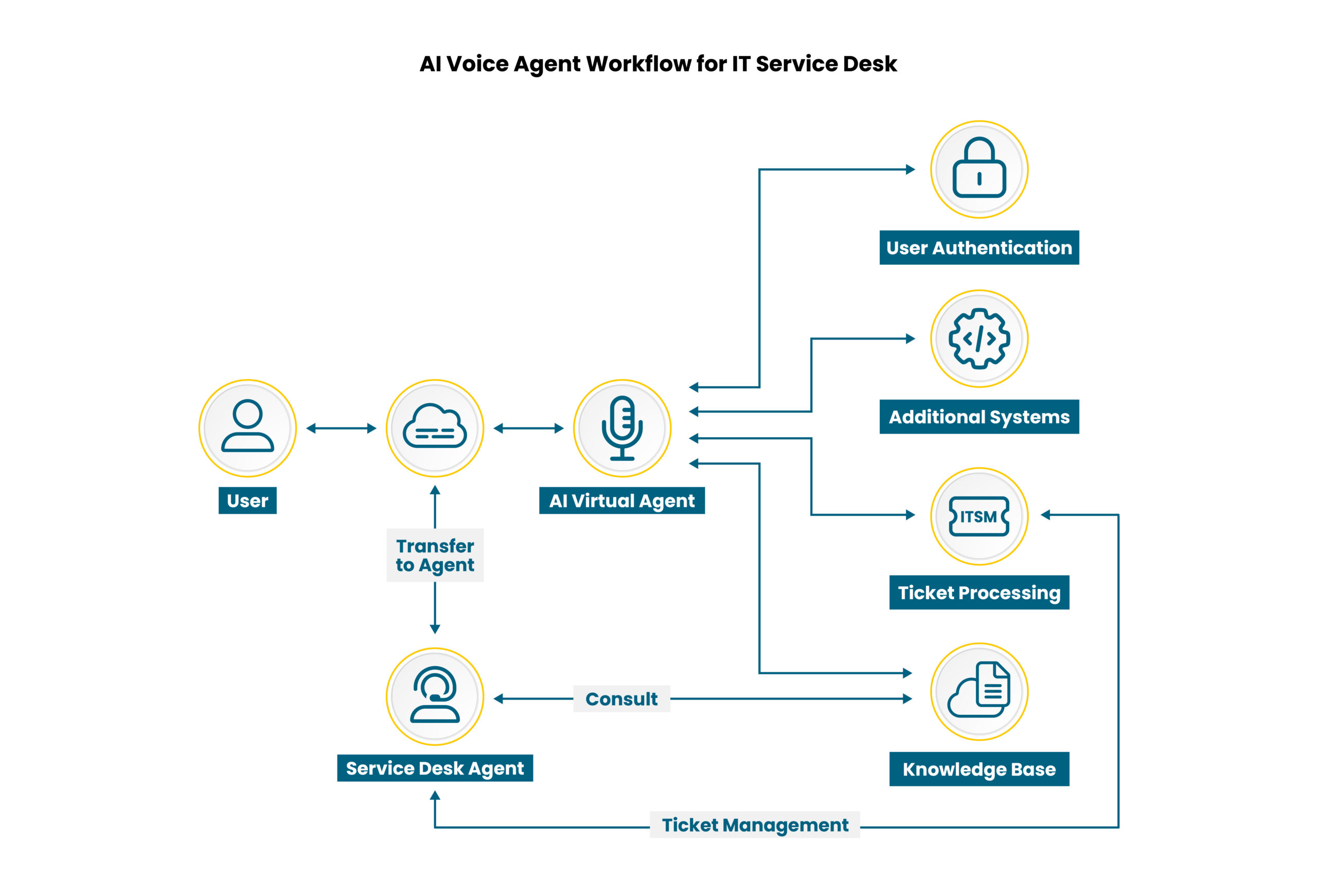
- Automating end-to-end workflows. Through integrations with authentication platforms, IT service management (ITSM) platforms, HR systems, and other enterprise applications, voice agents can execute approved workflows, guide users through resolution steps, and intelligently escalate issues when necessary.
- Enabling more personalized support. By leveraging caller history, location, and user preferences, AI voice agents can deliver more informed, efficient, and human-like interactions – improving resolution speed while reducing friction for both callers and live agents.
- Expanding multilingual support at scale. AI voice agents make it possible to provide native-language support across multiple languages without increasing headcount, helping organizations deliver more inclusive and globally scalable experiences.
- Reducing communication barriers. Some AI voice platforms now offer real-time speech modulation capabilities that can soften or neutralize accents during live conversations – modifying pronunciation and intonation to match a target accent while attempting to preserve the speaker’s original voice. By optimizing voice quality in real time, these tools can help reduce misunderstandings and improve communication between globally distributed users and support teams.
- Providing actionable analytics and insights. Built-in reporting capabilities allow organizations to track call deflection, resolution rates, response times, and customer experience metrics – helping teams continuously optimize performance, identify support gaps, and demonstrate measurable ROI.
- Scaling instantly during demand spikes. AI voice agents can rapidly scale to support surges in users or call volumes without adding more human agents – maintaining consistent speed, accuracy, and reliability during peak periods.
- Reduced costs. Automating routine support tasks, scaling support up or down as required, faster resolution, and reduced operational overhead (including hiring and training additional human agents) all contribute to reduced costs, with even conservative estimates showing 30x savings with AI agents.
Getting AI voice agents right for your help desk
The use cases for advanced virtual agents are numerous, particularly where there is a high volume of repetitive interactions that can be standardized and automated, while still maintaining a conversational experience.
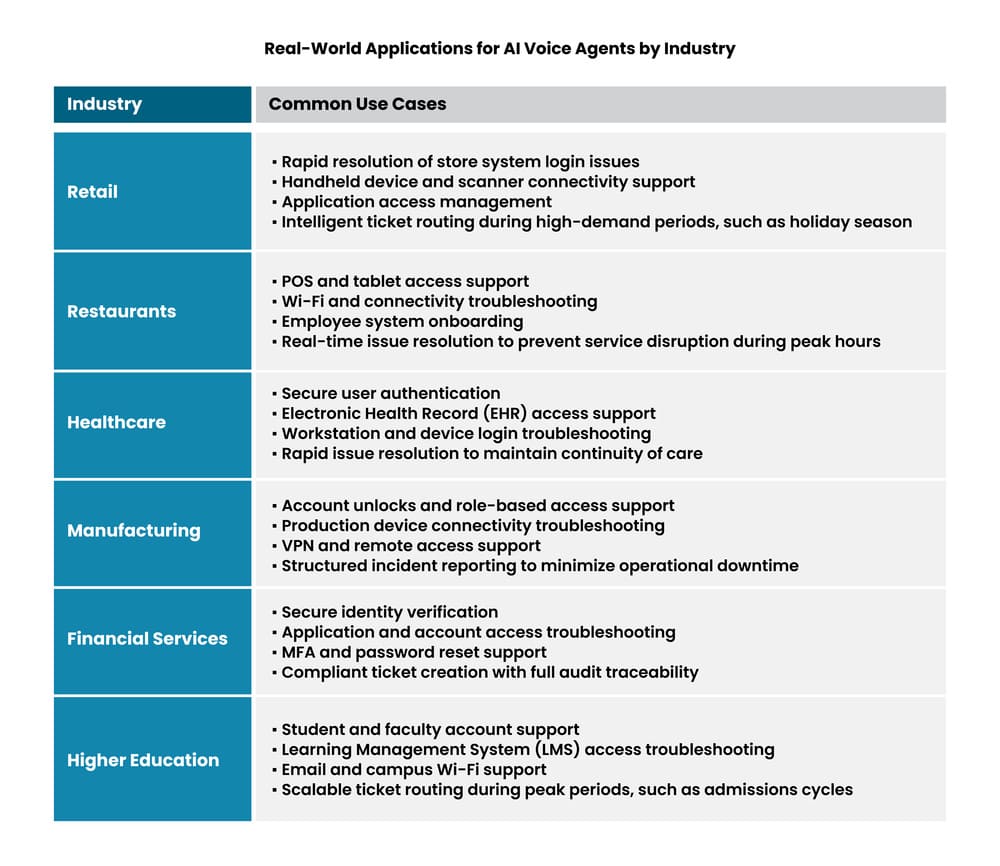
For instance, AI voice agents can play a big role in store support for fast‑paced, distributed retail environments where downtime directly impacts revenue and customer experience. With the ability to integrate with POS systems, ITSM platforms, and other enterprise tools, voice agents can automate issue resolution for high-volume, low-complexity issues, streamline ticket creation and escalation for higher-level issues, and trigger real-time system actions.
The result? Accelerated store operations and seamless end-to-end support during busy sales periods, as well as outside business hours.
Similarly, AI voice agents can be highly effective for IT support in universities, where demand is high, user needs are diverse, and support teams are often resource constrained.
Below we summarize some of the most common IT support use cases for AI voice agents in different industries.
AI voice agents for IT support: an Auxis case study
Focused on continuously advancing its service desk solutions, Auxis partnered with a next-generation voice orchestration platform powered by the latest GenAI multimodal models to develop intelligent voice agents. Initially deployed internally as the first level of IT support at Auxis, it is now being rolled out across multiple service desk clients.
The agent combines powerful real-time voice interaction and a conversational orchestration layer integrated with enterprise logic, ITSM platforms, and service desk workflows. With built-in multilingual capabilities, it can support 10+ languages and switch language mid-conversation at the user’s request – enabling faster, more inclusive, and personalized support.
The Auxis AI voice agent also includes several automations developed in-house that seamlessly perform actions that previously required extensive manual effort or multiple, siloed automations. These include:
- Faster, secure user authentication through Entra ID (previously Active Directory), the Microsoft platform that manages and authenticates users, computers, and resources within a networked environment. By validating caller credentials like employee ID and username in real time, the voice agent reduces manual verification time while enhancing security and enabling personalized support.
- Automated troubleshooting of common user issues by following approved workflows from selected knowledge bases, helping resolve issues faster and freeing human agents to work on more complex issues.
- Comprehensive ticket creation for more complex issues in the ITSM platform – complete with notes, context, and correct categorization – enabling faster prioritization and resolution by human agents. The AI agent also logs every interaction step into the ticket for full traceability and audit needs.
Designed with strict guardrails and governance frameworks to deliver accurate, compliant, and safe user interactions at every step, the voice agent is also compatible with agentic automation – incorporating easily into autonomous workflows to collaborate, make decisions, and act independently across systems as part of the next wave of intelligent service desk operations.
With every call automatically evaluated for First Call Resolution (FCR), escalation rate, and other critical metrics, the agent allows for constant performance measurement and optimization.
Working together with Auxis’ help desk personnel, the voice agent is freeing up technicians to focus on more complex conversations or urgent issues and proactive service improvements, presenting an optimal solution to enhance service quality, responsiveness, and operational efficiency – without raising costs concurrently.
The solution is delivering dramatic improvements in service desk operations:
- By serving as a first line of contact on every call made to IT support, the voice agent has led to zero call abandonment (down from 3% previously).
- The agent autonomously resolves about 40% of tickets, freeing human technicians to focus on more complex or urgent issues and proactive service improvements.
- While our help desk could previously handle a set number of calls concurrently, AI agents now scale automatically to meet any call volume.
- Significant improvement in ticket quality and consistency due to the agent’s structured data capture, helping human agents understand issues better and resolve them faster – driving higher user satisfaction.
- The agent can switch languages effortlessly if requested by the user – delivering inclusive service across geographies.
Hear the Auxis AI voice agents in action:
Why Auxis: Implementing service desk voice agents with the right partner
AI voice agents are playing an increasingly pivotal role in modernizing service desk operations and enabling them to meet the demands of a fast-paced, always-on digital workforce. Today, 60% of contact center and customer experience leaders are actively evaluating voice AI for customer service calls – and another 14% have already deployed the technology, PolyAI’s AI in Customer Service Trends report 2025 found.
At the same time, 53% say their current tech stack is not equipped to support voice AI implementation – highlighting a growing gap between interest and readiness.
Auxis, a Grant Thornton company, brings the right mix of deep service desk expertise, high-quality nearshore IT talent, and hands-on experience developing and implementing voice agents to help organizations deploy AI-powered support operations – safely, efficiently, and at scale.
Leveraging strategic technology partnerships and ITSM best practices refined through extensive service desk outsourcing experience, Auxis helps accelerate AI adoption while delivering measurable improvements in performance, cost optimization, and end-user satisfaction – freeing internal teams to focus on innovation and strategic support.
Want to learn more about how AI voice agents can support your IT service desk? Schedule a consultation with our help desk leaders today! Or visit our resource center to learn more about help desk trends, strategies, and success stories.
Frequently Asked Questions
Why is the rise of AI voice agents transforming customer service?
What is AI accent neutralization, and how does it improve customer interactions?
What is the ROI of implementing AI-powered voice agents for IT support?
How long does it typically take to implement AI voice agents for an IT service desk?
What should businesses look for when choosing an AI voice agent solution?
