Auxis & Grant Thornton join forces to set a new standard for modern advisory.
Implementing a shared services center requires more than a clear strategy. Without strong execution, migrating live processes and standing up new operations can lead to a rocky transition where inefficiencies worsen and business unit frustration escalates.
Backed by 30 years of shared services transformation experience, our team of experienced SSC advisors, hands-on outsourcers, and former industry operators combines deep process transformation and organizational change management expertise to take your project from start to finish. Our proven methodology uses clear stages, milestones, and checkpoints to maintain executive alignment while keeping us ahead of potential pitfalls and risks. We also help you embed AI, automation, and analytics into core business activities to drive measurable process improvement.
Because long-term performance requires more than a smooth launch, our work does not end at go-live. We maintain robust processes for stabilization that incorporate hyper-care and shared services optimization built around a continuous improvement strategy and metrics. Partnering with Auxis Grant Thornton delivers best practices and a proven implementation process that sets you well on the path to project ROI.
- Source: 2023 State of the Shared Services and Outsourcing Industry Global Market Report (Shared Services & Outsourcing Network (SSON))
As part of our shared services implementation capabilities, clients typically engage Auxis to lead a combination of the following engagements:
Fortune 1000 organizations across industries have relied on Auxis to deliver peak performance in their shared services centers since 1997. We don’t just come in as strategy consultants, we stay on as partners to ensure effective implementation and operational best practices.
As experienced advisors, former industry shared services operators, and hands-on BPO providers, we bring you real-world insights, best practices, digital capabilities, and operational strategies for achieving results-driven outcomes faster and more cost-effectively.
We recognize that one shared services model does not fit all. From fully captive centers to hybrid models, our solutions are customized to your specific needs and desired outcomes – delivering real benefits and ROI from every engagement.
Our skilled and qualified teams take you through the end-to-end transformation journey. We combine business and technical knowledge to assess, strategize, and implement intelligent automation, AI, machine learning, intelligent data capture, workflow tools, analytics, and more aligned to your business goals.
For customers who opt for a hybrid model with an outsourcing component, Auxis can also serve as your BPO and ITO partner with global experience supporting customers across the world from our nearshore centers in Costa Rica and Colombia. Our turnkey outsourcing solutions provide our clients with access to top talent and best-in-class processes and technologies to achieve optimal performance.
While we also help clients in their global shared services strategy, our experience in the Americas is unparalleled with over 25 years of experience helping North American companies leverage the power of nearshoring from LATAM. Whether you are looking to set up a captive center in the region or leverage a hybrid model, nobody else knows Latin America like we do.
With years of industry experience and consultancy qualifications, we bring subject matter experts across business functions. That includes finance and accounting, information technology, human resources, customer service, and other industry-specific business operations.
We want to learn more about your organization and help you achieve your goals.
Watch our exclusive webinar on demand.
Case Study
Case Study
Case Study
Case Study
Case Study
A shared services model centralizes business support functions like finance, HR, and IT into a dedicated unit. It helps reduce redundancy, standardize processes, and improve efficiency through scale and streamlined service delivery.
Shared services help organizations reduce costs, eliminate process duplication, and improve service consistency. The model also enables better performance tracking, can accelerate automation, and creates a scalable foundation for future growth.
The first step is conducting a comprehensive assessment of current processes, costs, and service levels across departments. This helps identify opportunities for centralization, standardization, and automation, and forms the foundation for a tailored shared services strategy. Partnering with an experienced shared services consulting company can help you define and execute a successful implementation roadmap.
Implementation timelines vary, but SSON (Shared Services & Outsourcing Network) insights suggest that implementing a shared services or GBS model is often a multi-year effort, typically spanning 12 to 36 months before reaching operational maturity. Implementation timelines also depend on the organization’s size, scope, and readiness. The most successful deployments involve multiple stages, milestones, and checkpoints to ensure all activities are performed thoroughly and completely and receive validation from stakeholders.
Common challenges include resistance to change, lack of process standardization, and technology integration issues. Successful implementations focus on strong change management, clear governance, consistent communication, and a structured stabilization process to drive adoption and results.
In a traditional model, departments or locations manage their own support staff separately, often resulting in duplication, inconsistent practices, and higher costs. Shared services consolidate these functions into a centralized unit, enabling standardization, greater efficiency, economies of scale, and improved service quality across the business.
Shared services typically perform functions such as finance and accounting, human resources, IT, procurement, customer service, and supply chain operations. These areas involve high volumes of repeatable processes that benefit from centralization and standardization.
Outsourcing is one type of shared services model, where an external provider delivers business support functions — typically to reduce costs, tap into specialized expertise, or speed up technology adoption. Shared services can also be “captive,” meaning the organization owns and operates the centralized service center in-house.
Shared services may be a good fit if your organization has multiple business units performing similar support functions, struggles with inefficiencies or inconsistent service delivery, or is looking to scale operations while controlling costs. A structured assessment of process maturity, volume, and standardization potential can help determine readiness. Schedule a consultation with Auxis today to see if your business can benefit from a shared services model.
Looking to go from idea to peak performance? Auxis can help.
"*" indicates required fields
Report
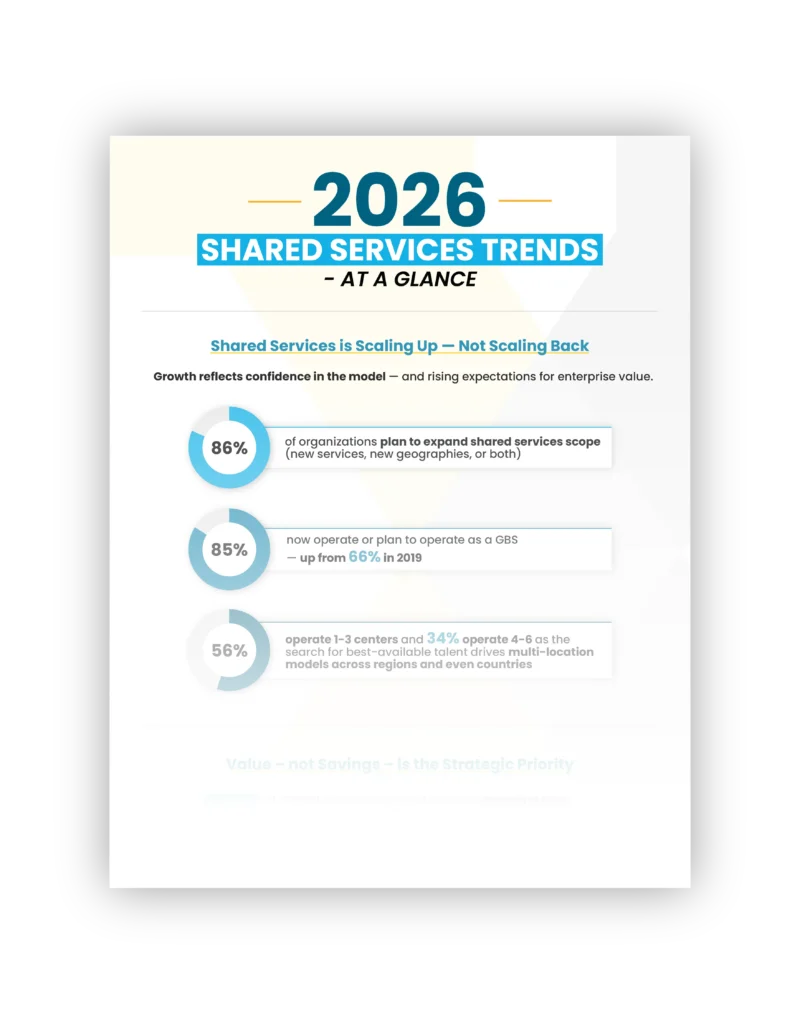
Infographic
Whitepaper
Report
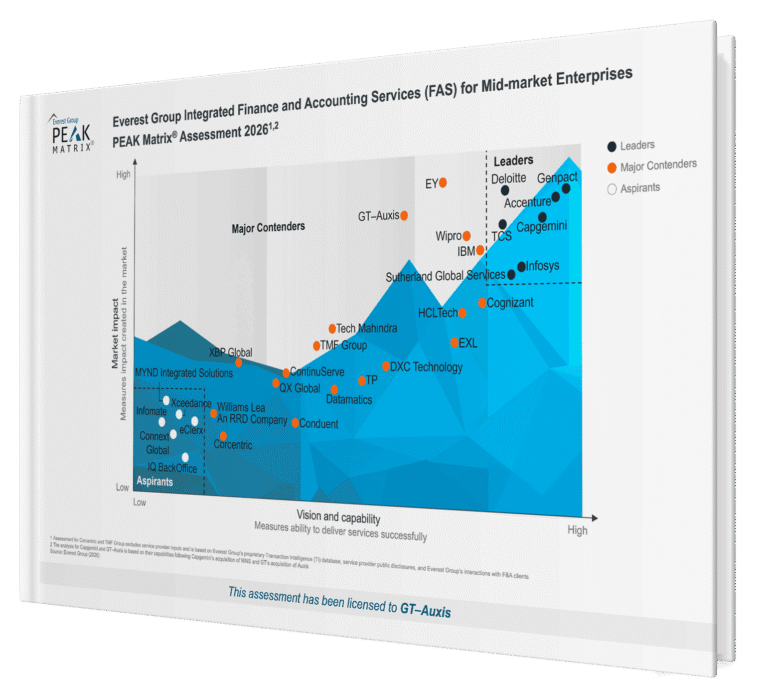
Everest Group Integrated Finance and Accounting Services (FAS) for Mid-market Enterprises PEAK Matrix® Assessment 2026