


In brief:
- Digital transformation remains the top investment priority, yet only 8% of organizations say their AI initiatives are meeting performance expectations.
- Businesses are embracing an operate-to-transform outsourcing model that combines operational execution with end-to-end modernization — reducing execution costs and risks.
- Operate-to-transform turns guaranteed outsourcing savings into a self-funding engine for AI, automation and continuous modernization — without new capital investment.
- Nearshoring strengthens the model with skilled tech talent and real-time collaboration, enabling faster decision-making, closer executive alignment and more agile transformation.
Organizations are investing heavily in AI, but most struggle to translate their investments into measurable business value.
Digital transformation remains the top investment priority in Grant Thornton’s Q2 CFO Survey, with 67% of senior finance leaders expecting technology spending to increase. Yet only 8% of organizations say their AI initiatives are meeting performance expectations, Grant Thornton’s 2026 AI Impact Survey found.
Here’s the challenge: While AI introduces unprecedented capabilities, technology alone doesn’t create lasting competitive advantage. The organizations realizing the greatest returns are building intelligent operations — where AI, people and operational expertise work together to continuously improve performance, adapt faster and drive better business outcomes.
As a result, many business leaders are rethinking how transformation gets done. Increasingly, they are embracing an operate-to-transform outsourcing model that combines operational execution with end-to-end modernization — embedding AI and continuous improvement into day-to-day operations while reducing transformation costs and risks.
What is operate-to-transform outsourcing?
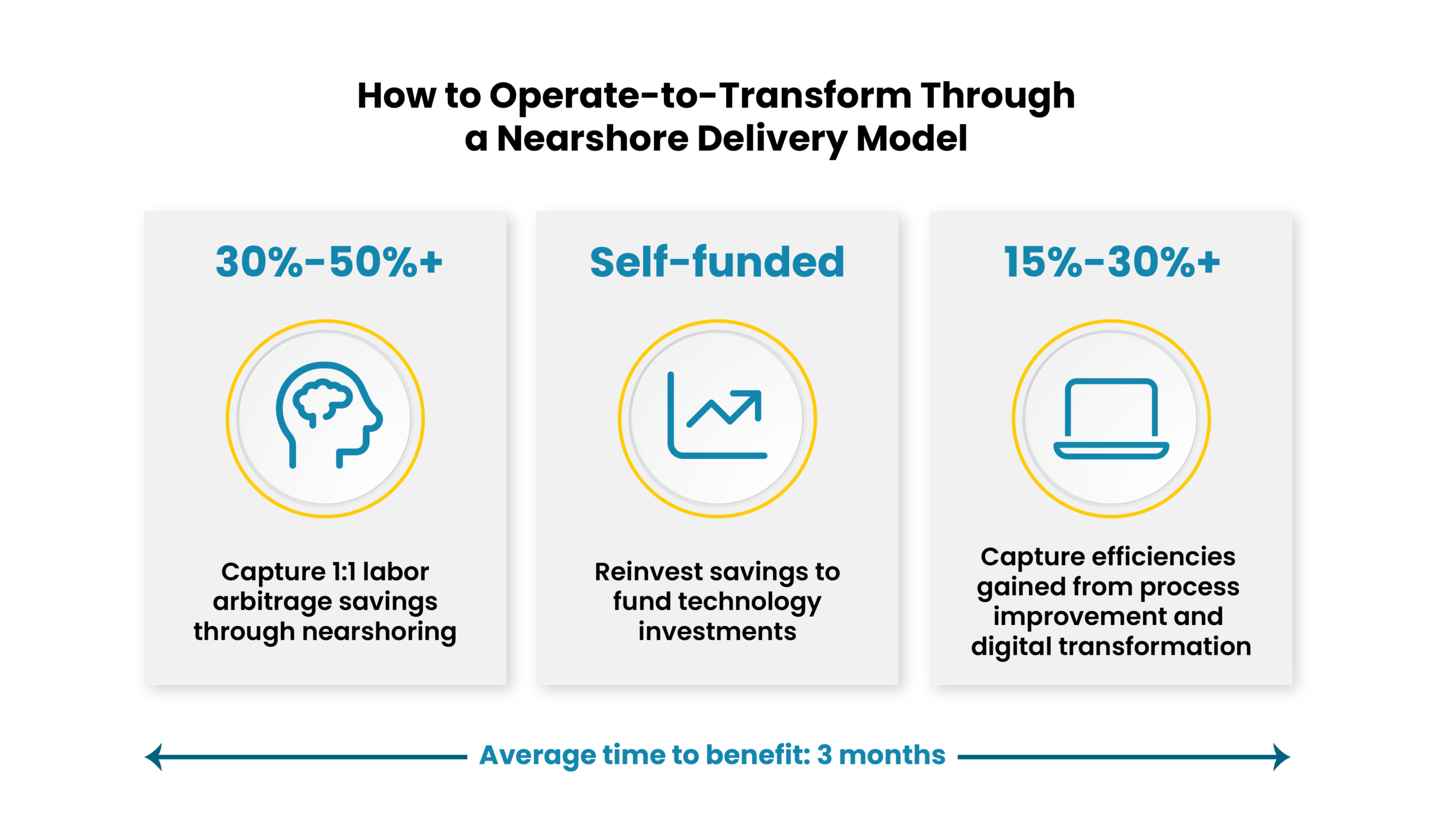
Operate to transform represents a different approach to outsourcing — one that goes beyond labor savings to help organizations modernize operations, accelerate AI ROI and fund continuous transformation without a new capital investment.
Rather than treating transformation as a separate initiative, this model uses guaranteed outsourcing savings to finance AI and automation investments. The technology is then integrated directly into outsourced operations with accountability for business outcomes.
The result is an operating model that frees internal teams to focus on strategic priorities while improving the intelligence, efficiency, scalability and resilience of business operations.
This approach marks a significant departure from the traditional view that organizations must first standardize processes, stabilize operations and complete transformation before outsourcing. Instead, more organizations are prioritizing strategic partnerships that combine advisory, digital transformation and operational execution into a single platform — modernizing the business while work gets done.
“Operate-to-transform changes the economics of modernization,” said Keith Sayewitz, Auxis Grant Thornton Partner, Finance and Business Transformation & BPO. “Instead of treating transformation as a large capital project with uncertain returns, organizations can build it into the way work gets done every day — creating a self-funding model that accelerates the transition to intelligent operations while driving continuous innovation and improvement.”

“Instead of treating transformation as a large capital project with uncertain returns, organizations can build it into the way work gets done every day — creating a self-funding model that accelerates the transition to intelligent operations while driving continuous innovation and improvement.”
Auxis Grant Thornton Partner,
Finance and Business Transformation & BPO
4 ways operate-to-transform outsourcing accelerates AI transformation
Operate-to-transform outsourcing helps organizations build intelligent operating models while overcoming many of the barriers that often derail AI and digital transformation initiatives. Together, these capabilities help explain why the model is gaining traction as organizations look for faster, lower-risk paths to AI-enabled modernization.
1. Use outsourcing cost savings to self-fund transformation
With 87% of CFOs in Grant Thornton’s Q2 survey expecting to cut costs in at least one area amid rising economic uncertainty, organizations face a difficult balancing act: driving AI and digital transformation while controlling spending.
Traditional transformation programs often require significant upfront capital investment, with meaningful value realized over time — if at all. While 60% of finance leaders rank tech-driven transformation as a top value creation priority, just 12% say their AI initiatives have provided more than a moderate revenue uplift, Grant Thornton’s CFO and AI Impact surveys found.
An operate-to-transform outsourcing model changes that equation. Rather than relying on new investments, organizations use savings generated through outsourcing efficiencies and labor arbitrage to fund modernization, while ongoing automation and continuous improvement create additional savings over time.
The result is a self-funding transformation cycle — where each efficiency gain helps finance the next wave of innovation while reducing financial risk and accelerating time to value.
2. Access specialized expertise and AI-ready talent
Just 12% of organizations say their workforce is fully AI-ready, Grant Thornton’s AI Impact survey found — underlining a key barrier to success.

AI transformation demands deep operational knowledge to identify the highest-value opportunities, redesign processes, integrate AI into operations and drive long-term adoption. Yet these capabilities remain difficult and expensive to build internally as demand for AI talent continues to outpace supply.
Operate-to-transform models provide access to experienced AI professionals, operational best practices and business operations teams already used to working alongside AI-enabled processes. Organizations can accelerate execution and reduce the learning curve without the time, cost and risk of building these capabilities internally.
“AI changes the nature of work — not the importance of people,” said Raul Vega, Auxis Grant Thornton Partner & CEO. “AI becomes exponentially more valuable when combined with human judgment, creativity, leadership and deep operational expertise.”

“AI changes the nature of work — not the importance of people.“
– Raul Vega,
Partner & CEO, Auxis Grant Thornton
But expertise is only part of the equation — maximizing the value of transformation requires frequent collaboration between business stakeholders and delivery teams. Increasingly, nearshoring is emerging as an attractive solution for building intelligent operations — combining skilled tech talent with proximity that supports real-time communication, fast decision-making and close alignment with executive teams.
As organizations increasingly outsource time-sensitive, judgment-intensive and high-touch work, 44% of finance leaders are now operating with or evaluating nearshore delivery partners, Grant Thornton’s Q2 CFO survey found.
“AI transformation succeeds when technology teams and business teams solve problems together,” Sayewitz said. “Nearshoring makes it easier to transfer knowledge, adapt quickly, innovate and capture value as business priorities evolve.”
3. Create the foundation for AI success
Beyond specialized talent, organizations need standardized processes, trusted data, effective governance and a clear roadmap before AI transformation can succeed at scale.
Yet many struggle to build this critical foundation because the work requires coordinated changes across processes, data, governance and operating models.
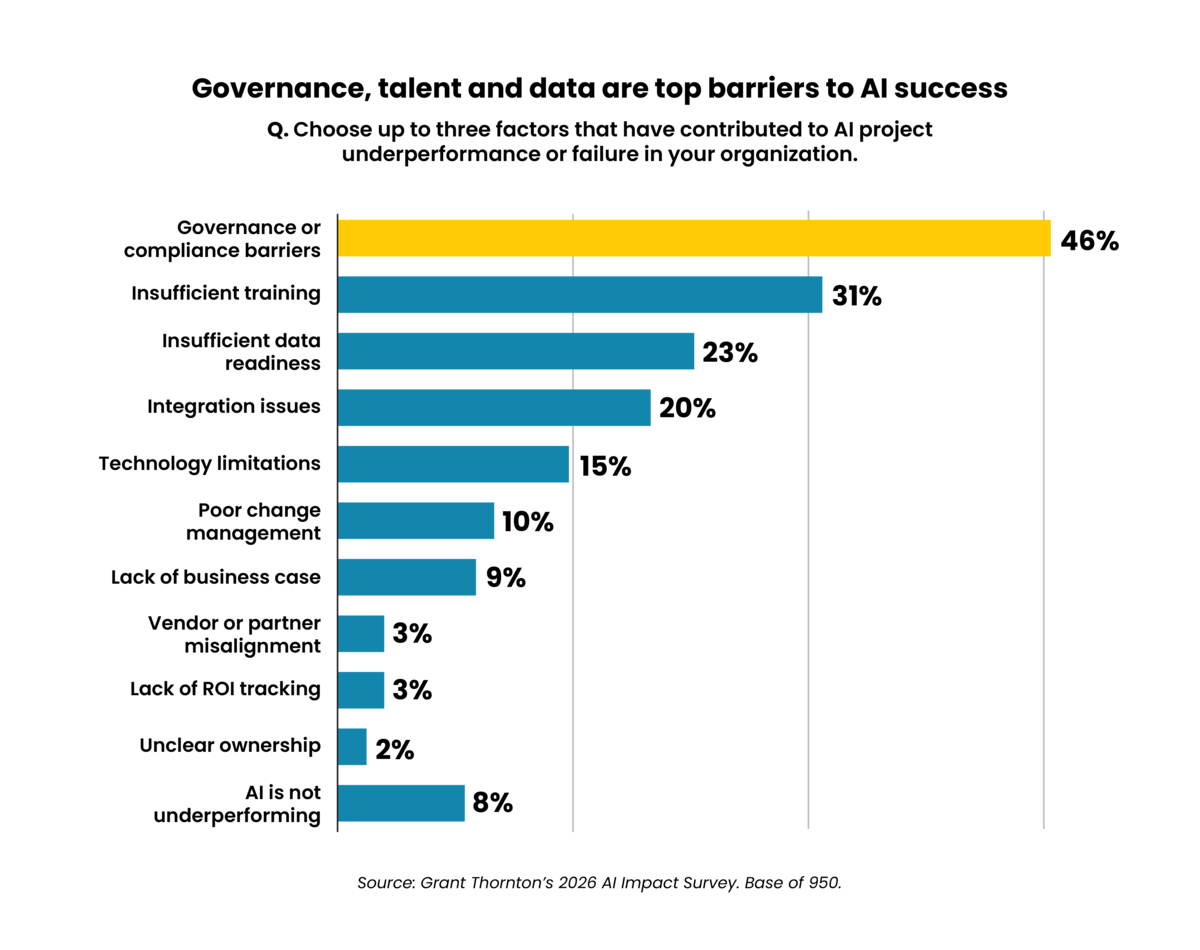
Managing separate consulting, technology implementation and outsourcing vendors often adds to the challenge — creating disconnected efforts, data silos and competing priorities that slow execution and dilute accountability.
An operate-to-transform approach addresses these gaps by combining those core capabilities into a single delivery model. Instead of layering AI onto inefficient processes, partners optimize workflows, improve operating models and modernize data foundations.
Outsourcing done right also establishes the governance needed to scale AI responsibly, including data quality, human oversight, cybersecurity and regulatory compliance.
4. Lower execution risk
AI initiatives often stall because organizations lack the capacity to transform the business while running it.
An operate-to-transform model transfers execution responsibility to a partner with business modernization credentials, proven implementation methodologies and contractual performance commitments — reducing the burden on internal teams while improving accountability for results.
The impact extends beyond execution. Organizations with AI fully integrated into their operations are nearly four times more likely to report revenue growth than those still piloting the technology.
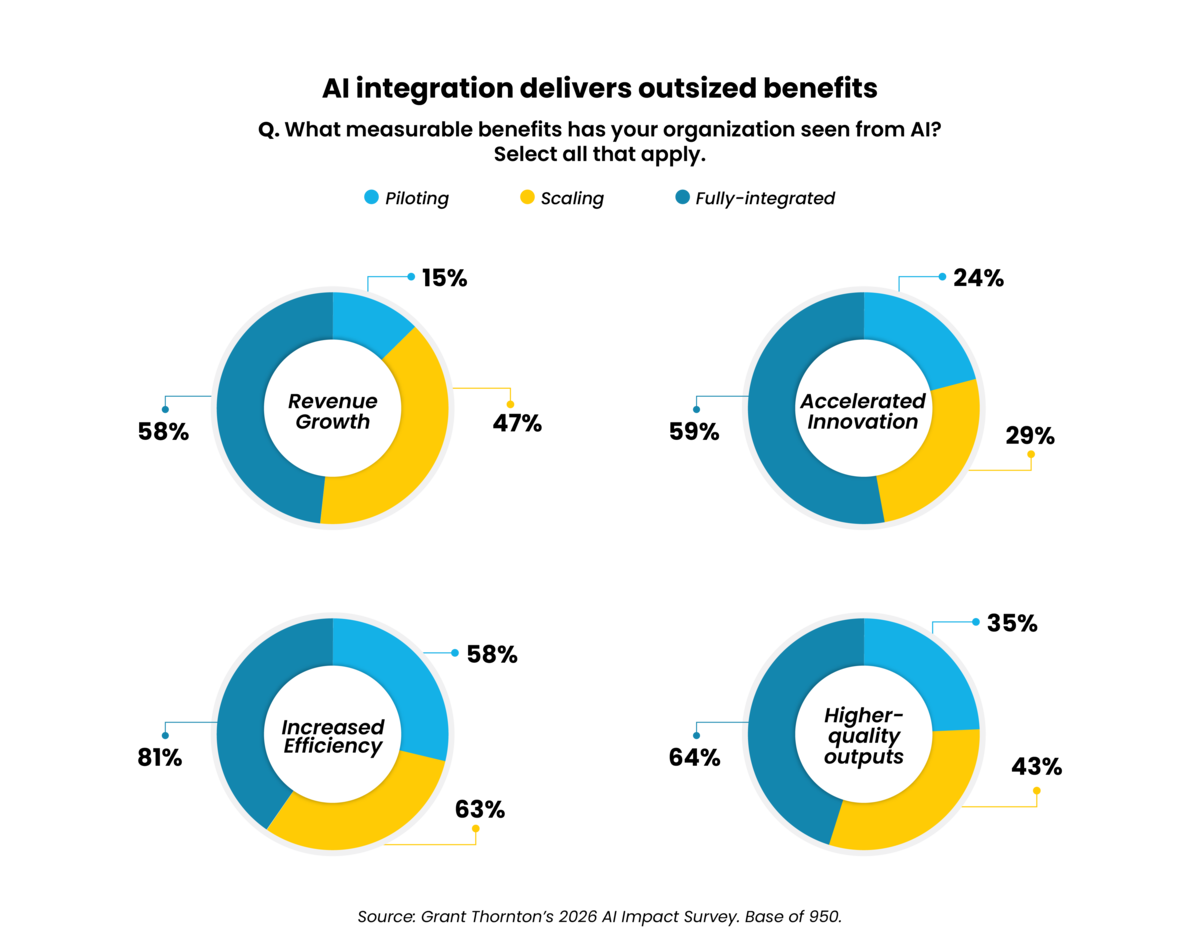
“The organizations seeing the greatest return from AI aren’t necessarily investing more — they’re executing better,” Sayewitz said. “When AI is integrated into intelligent operating models with trusted governance and operational discipline, organizations can scale with confidence and realize ROI faster.”
Building an intelligent operating model
As AI reshapes how businesses operate, realizing its full value depends on building the right operational foundation.
Organizations that embrace an operate-to-transform outsourcing approach can bridge the traditional gap between strategy and execution — achieving intelligent operations through a self-funded transformation model that accelerates innovation and drives long-term results.
“Transformation is no longer a project with a defined end state. It becomes an operating discipline built on continuous learning, continuous adaptation and continuous improvement,” Vega said. “In that model, every investment in technology, operations and AI should increase the organization’s capacity to create value — not simply reduce the cost of enabling it.”
Want to learn more about how operate-to-transform outsourcing can accelerate value for your organization? Contact our outsourcing experts today! Or, visit our resource center for more outsourcing tips, strategies, and success stories.
