




In brief
- Traditional finance benchmarks remain essential in the AI era, helping CFOs identify performance gaps and prioritize opportunities for improvement.
- AI is raising the bar for traditional finance KPIs, while emerging measures provide greater visibility into the capabilities driving those gains.
- AI success is increasingly measured by business outcomes, not deployment activity — including productivity, decision quality, cost, working capital, and ROI.
- Realizing AI ROI requires a strong operational foundation, with optimized processes, quality data, skilled talent, integrated systems, governance, and operational expertise critical to success.
Finance benchmarking has long helped CFOs understand how their organization stacks up against peers. Financial performance metrics such as Cost per Invoice, Invoices Processed per FTE, Days Sales Outstanding (DSO), Days to Close, and Number of FTEs have traditionally helped organizations identify opportunities to improve cost, productivity, and performance.
AI is not only changing how organizations improve these measures — it’s expanding how finance performance itself is measured.
For decades, finance organizations improved benchmark performance through initiatives such as process standardization, centralization, shared services, and workflow automation. Today, AI is becoming another powerful operational lever, with applications designed to help organizations reduce manual work, improve accuracy, accelerate decision-making, and increase productivity across the same finance processes organizations have benchmarked for years.
As a result, benchmarking authorities like the American Productivity & Quality Center (APQC) are introducing new measures that help organizations assess the impact of AI and automation on finance operations.

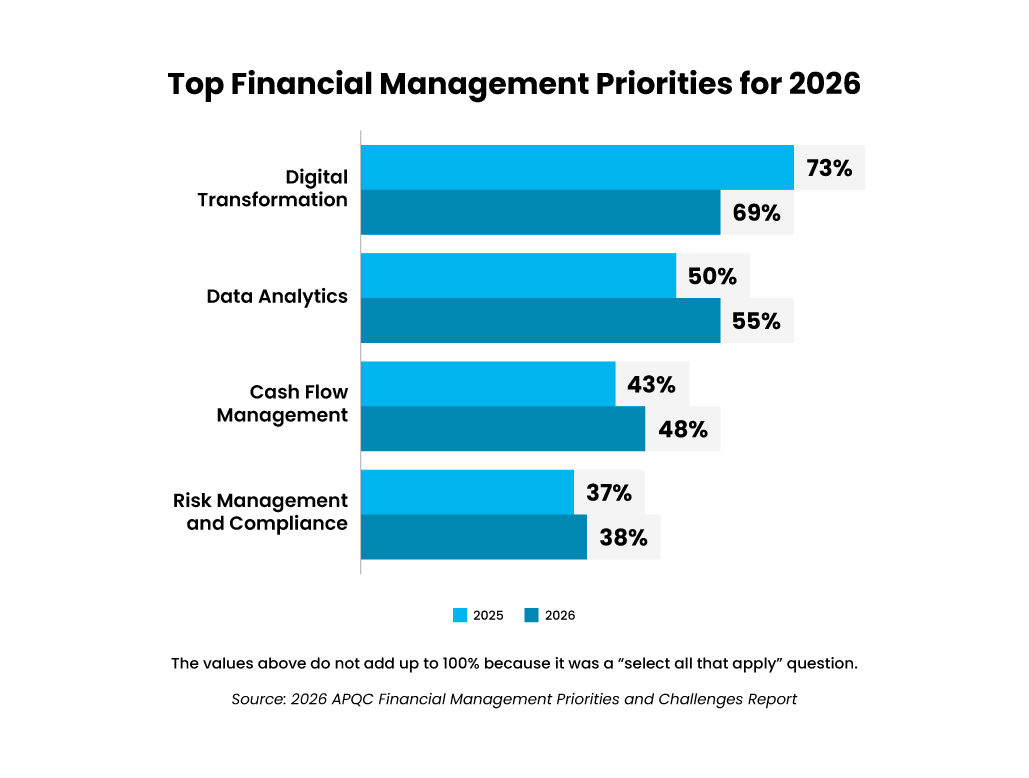
This shift reflects broader CFO priorities. APQC’s 2026 Financial Management Priorities and Challenges Report shows 69% of finance leaders identifying digital transformation as their top priority.
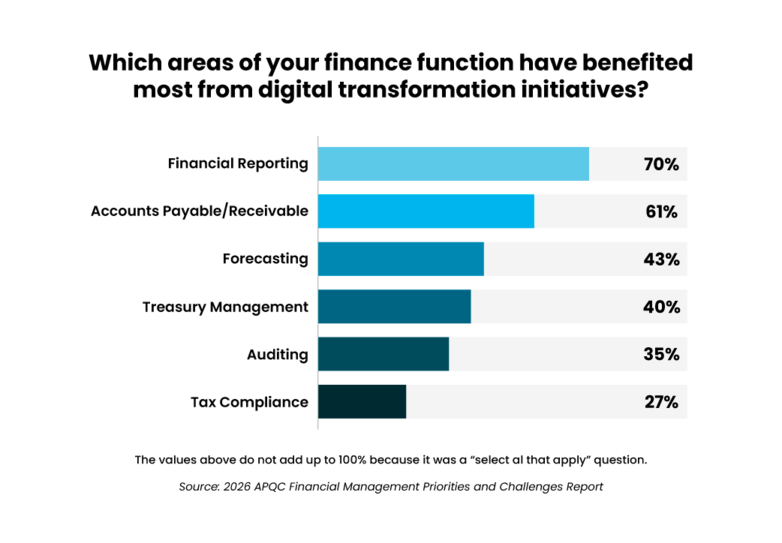
The benefits are already becoming evident. Seventy percent of finance leaders report digital transformation initiatives, including automation and emerging AI capabilities, have delivered the greatest improvements in financial reporting, while 61% cite improvements in accounts payable and accounts receivable.
Finance leaders identify reduced manual processes (69%) and improved accuracy (68%) as the most significant impacts.
AI is becoming embedded in core finance processes – but ROI challenges remain
The conversation around AI in finance has evolved rapidly over the past years. According to APQC’s latest research on cross-industry AI trends, the discussion has shifted from whether organizations should adopt AI to how they can optimize its use to generate measurable business value.
Between 2024 and 2025, organizations moved aggressively from experimentation to pilot programs and early deployment. By 2026, AI adoption has become part of the broader digital finance landscape.
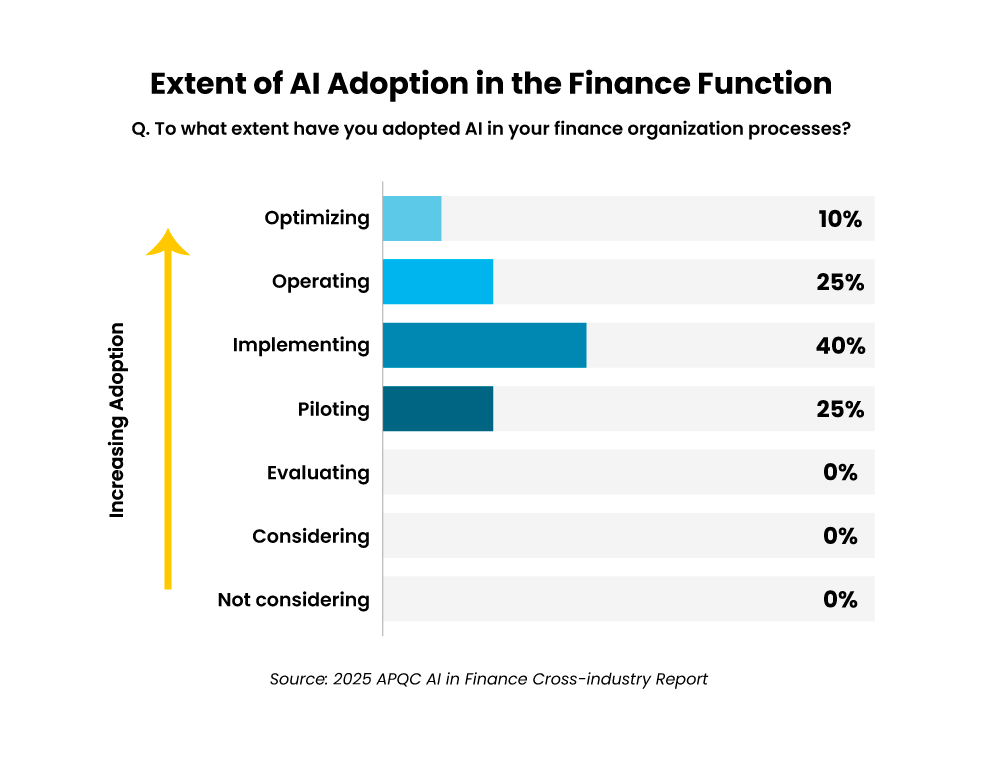
More than 600 finance leaders reported their organization was already piloting, implementing, operating, or optimizing AI within the finance function, APQC found. None indicated they were still simply evaluating the technology.
Yet while adoption has become widespread, evidence of sustained improvements in operational performance remains limited. Grant Thornton’s 2026 AI Impact Survey found that while three in four boards have approved major AI investments, only 12% of organizations report more than a moderate revenue lift.
Most of the market sits in pilot and implementation, APQC found, still building the governance, integration, and workforce capabilities needed to fully realize AI’s value. At this early stage, many organizations are still working to translate early AI gains into enterprise-wide results.
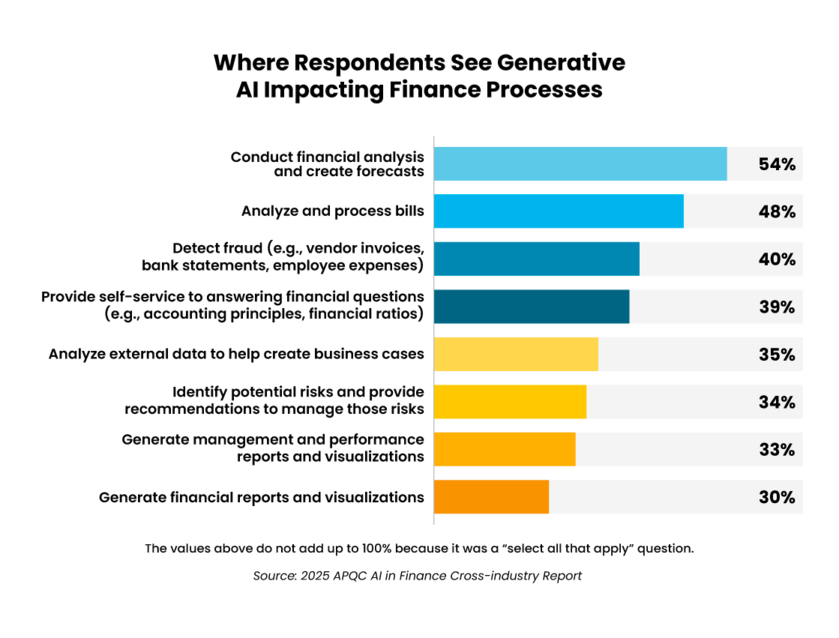
As organizations move forward, many of the biggest opportunities for AI are emerging in the same finance processes they have benchmarked for years. More than half (54%) of finance leaders point to financial analysis and forecasting as the area Generative AI in finance and accounting will impact most, while 48% name invoice and bill processing.
Agentic AI represents the next evolution. Unlike GenAI tools that primarily respond to prompts, AI agents can make decisions and take actions across finance workflows with varying levels of human oversight.
As adoption grows, these agents have the potential to extend automation into more complex, judgment-based activities such as reconciliations, forecasting, exception management, market analysis, and transaction processing.
Gartner’s 2026 Agentic AI in Finance report reveals 57% of finance teams are already implementing or planning to implement agentic technology. By 2030, Gartner predicts 70% of finance functions will use AI for real-time decision-making.
The takeaway is clear: AI is beginning to change how finance work gets done. The bigger challenge for finance leaders is translating growing adoption into measurable improvements in productivity, accuracy, cycle times, cost, and other established finance benchmarks.
How AI can improve benchmark performance
Benchmarking identifies where operational performance falls behind peers and where the greatest opportunities for improvement may exist. AI can help organizations close those gaps by addressing the operational challenges that drive underperformance.
Rather than introducing entirely new performance objectives, AI and finance automation enable organizations to execute existing finance processes more efficiently, accurately, and consistently.
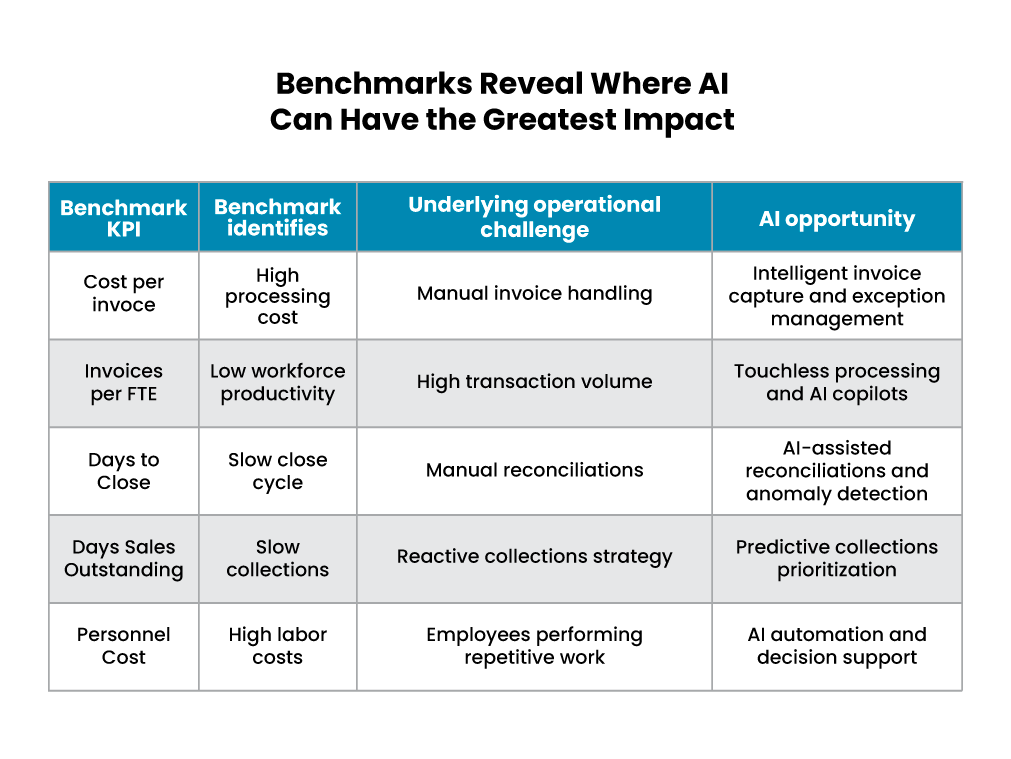
Research points to both emerging and expected operational gains from AI, automation, and intelligent technologies.
APQC’s latest Procure-to-Pay research found organizations implementing automation and intelligent technologies are achieving multiple benefits:
- 40% report faster process cycle times
- 41% report lower transaction costs
- 42% cite improved compliance
- 50% report greater visibility across procure-to-pay operations.
Gartner predicts finance organizations using cloud ERP applications with embedded AI assistants will achieve a 30% faster financial close by 2028 (Five Emerging Themes in Cloud ERP Will Reshape the Finance Function).
APQC benchmarks also show significant declines in headcount relative to revenue over the past seven years — about 18% across every performance level in accounts receivable, 15-18% in general accounting, and 21% in accounts payable — likely reflecting, at least in part, the growing impact of AI and automation.
Of course, technology alone can’t turn a Bottom Performer into a Top Performer. Apply AI to the wrong process and you risk investing without meaningful return; apply it to a broken process and you may simply automate inefficiency.
How finance benchmarking is evolving alongside AI
While traditional finance & accounting KPIs remain the foundation of benchmarking, organizations are beginning to expand what they measure as AI becomes more deeply integrated into finance operations.
Recent APQC research, discussions with APQC benchmarking experts, and recent updates to its Finance Measure Inventory indicate finance benchmarking metrics are evolving into two complementary approaches for measuring performance:
- First, organizations continue to measure traditional operational outcomes such as cost, productivity, quality, and cycle time.
- Second, organizations are beginning to introduce AI metrics that provide greater visibility into the capabilities driving those results.
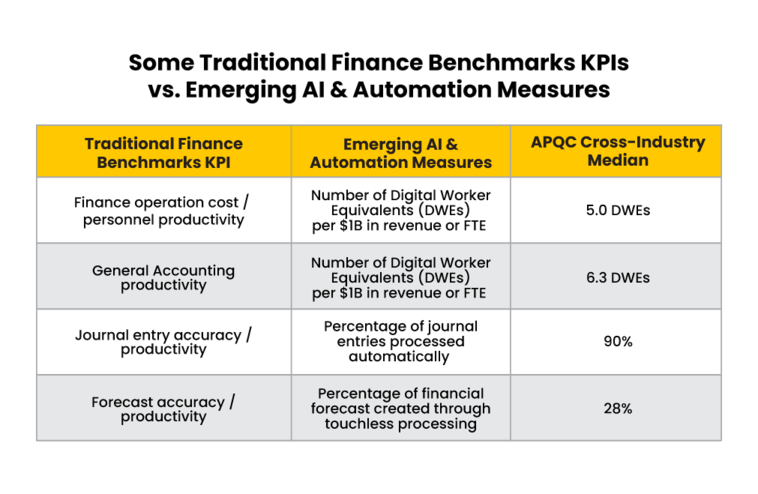
Reflecting this shift, APQC has expanded its Finance Measure Inventory to include 65 AI- and automation-related measures, including Digital Worker Equivalents (DWEs), which translate work performed by automation into the equivalent capacity of human full-time employees (FTEs). Other AI benchmarking metrics include touchless transaction rates, automation coverage, AI-assisted processing, AI maturity, and AI investment and ROI.
These emerging measures don’t replace traditional benchmarks — rather, they provide additional context for understanding the capabilities that are contributing to benchmark performance.
For example, lower costs per invoice, shorter close cycles, or a higher number of error-free transactions show what improved. Complementary AI measures such as DWEs, touchless transactions rates, or automation coverage help explain how — revealing the operational changes driving those improvements.
Measuring AI success: from activity to business outcomes
As AI adoption matures, the definition of success is changing with it.
Early AI performance metrics often focused on activity — pilots launched, models deployed, or hours saved. Increasingly, however, finance leaders recognize these measures provide only a partial view of AI’s value.
Recent Gartner research highlights a growing disconnect: Finance organizations often concentrate AI investment on productivity improvements, while boards place greater emphasis on enterprise outcomes such as improved decision quality, growth, and competitive advantage. Gartner recommends shifting AI measurement away from deployment activity toward improvements tied directly to organizational performance.
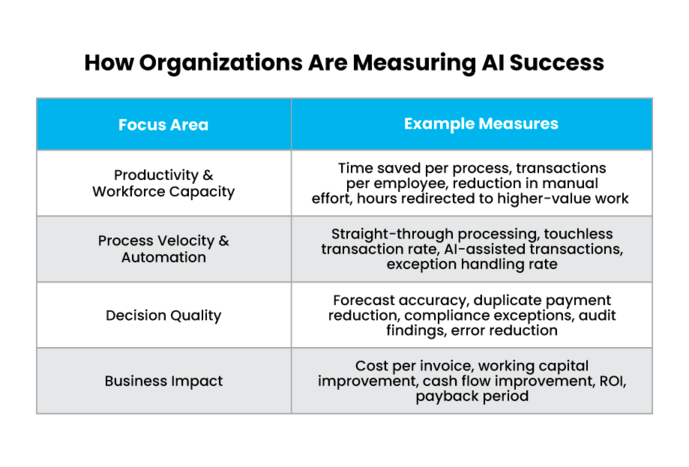
Leading organizations are increasingly evaluating AI across four broad outcome areas:
Operational readiness drives AI — and benchmark — performance
AI can amplify a strong finance operation, but it cannot compensate for fundamental weaknesses in how that operation is designed and managed. Realizing meaningful gains requires the right operational foundation — standardized processes, simplified business rules, quality data, integrated systems, strong governance, AI-ready talent, and people with the skills and operational expertise to improve the way finance teams work.
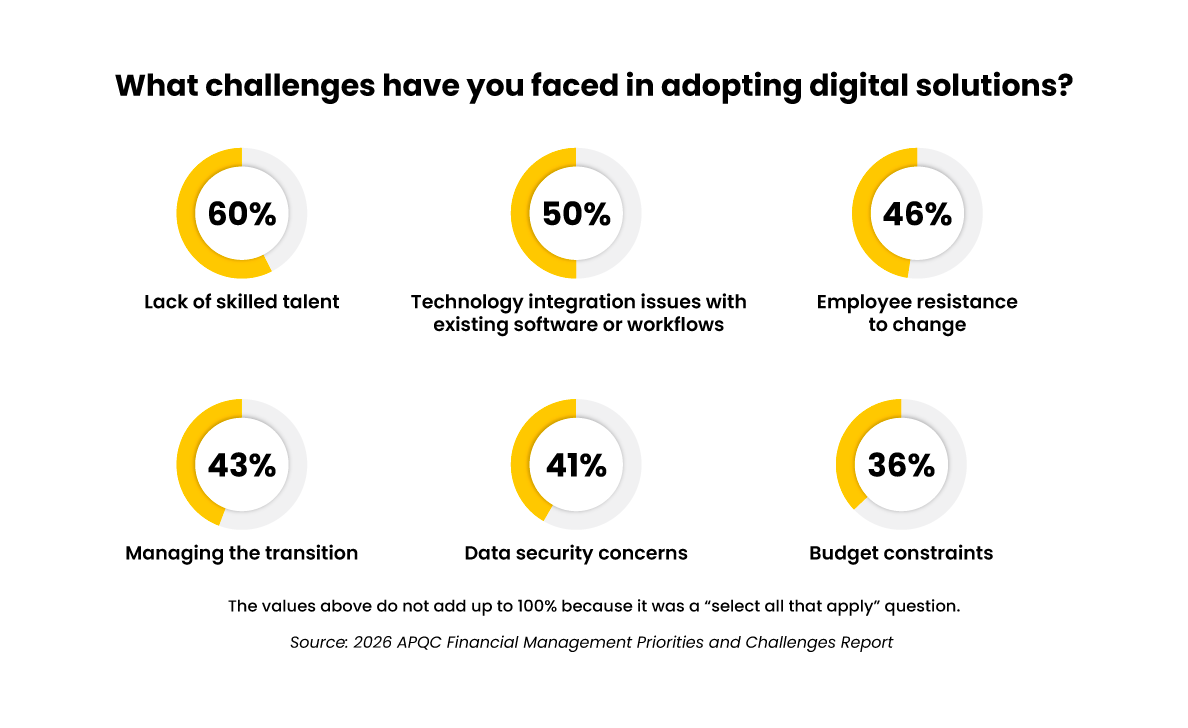
Operational readiness remains one of the biggest barriers to translating AI investment into measurable benchmark improvement. According to APQC’s financial management report, the leading obstacles to digital transformation are a lack of skilled talent (60%), difficulty integrating technology with existing systems and workflows (50%), and employee resistance to change (46%).
To strengthen AI readiness, APQC recommends:
- Using process mining to identify operational gaps and high-value AI opportunities
- Building well-governed, high-quality data foundations
- Integrating and standardizing data across finance processes
- Developing workforce skills to support AI and machine learning
These priorities closely mirror many of the characteristics of top-performing finance and accounting organizations. But they also need to be guided by a clear AI strategy. Grant Thornton’s AI Impact Survey reports more than half of executives identified strategy as the single biggest driver of AI ROI, yet only 22% have a fully developed enterprise AI strategy.
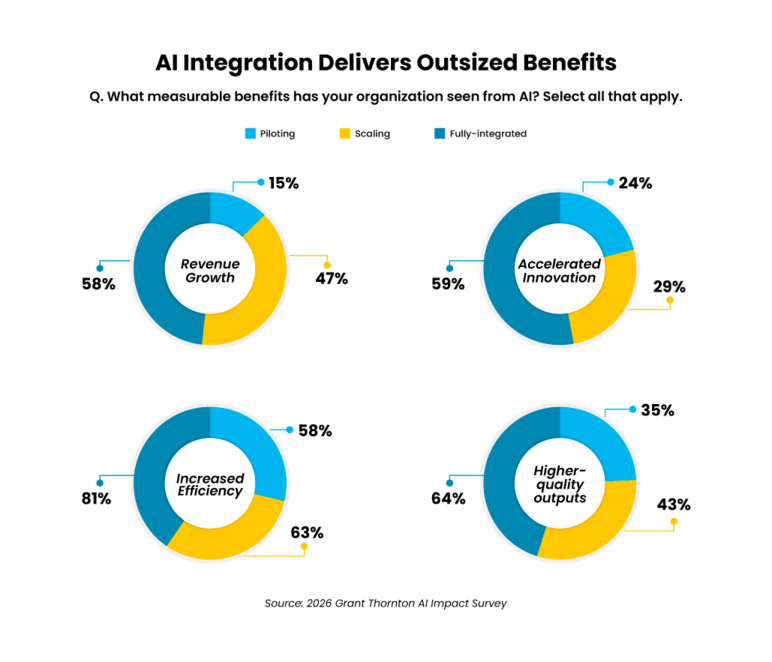
Grant Thornton also found an association between AI maturity and stronger reported outcomes. Organizations with fully integrated AI report higher efficiency (81%), higher-quality outputs (64%), accelerated innovation (59%), and revenue growth (58%).
Yet for many finance organizations, building and scaling AI capabilities internally is challenging. Talent shortages, limited transformation bandwidth, competing priorities, and gaps in AI and operational expertise can make it difficult to move from experimentation to the enterprise-scale execution that drives better performance.
That’s where finance outsourcing is increasingly playing a larger role. Moving beyond labor arbitrage and transactional support, leading providers bring the specialized finance, operational, and technology expertise organizations need to modernize the business while operating it.
Some 60% of organizations are leveraging the finance transformation talent and knowledge of existing outsourcing relationships to accelerate AI, while 57% are establishing new partnerships, according to Deloitte’s latest global outsourcing survey.
Increasingly, organizations are embracing operate-to-transform outsourcing models that bring operations and transformation together. This approach uses guaranteed outsourcing savings to self-fund modernization, while continuously embedding process improvement and AI into well-governed operations tied to measurable performance outcomes to lower risk.
The result is a path toward intelligent operations — where people, processes, operational expertise, and technology work together to continuously improve performance, adapt faster, drive better business outcomes, and raise benchmark results.
Turn AI investment into measurable finance performance
Ultimately, AI does not change the purpose of finance benchmarking — it makes benchmarking even more important. As new capabilities reshape how work gets done, CFOs need a clear baseline for determining whether their investments are translating into better business performance.
APQC’s AI in Finance ROI research reports a median 15% ROI from finance AI initiatives, highlighting both the potential opportunity and the importance of measuring actual results.
For CFOs, the takeaway is simple: benchmark performance first, then determine where AI can move the needle. Prioritize AI investments against measurable performance gaps, establish baseline KPIs before implementation, and measure whether investments are delivering sustained improvement against the outcomes that matter.
The goal isn’t better AI performance, it’s better finance performance — with AI as just one of the tools to get there.
Ready to turn benchmark insights into better finance performance? Recognized as a leading global finance outsourcing provider and backed by the power of Grant Thornton, Auxis Grant Thornton brings together deep finance and operational expertise with advanced AI and automation capabilities to help organizations close performance gaps and build more intelligent, scalable, high-performing finance operations. Contact our finance outsourcing experts today! Or, visit our resource center for more finance outsourcing tips, strategies, and success stories.
Frequently Asked Questions
How is AI changing finance benchmarking?
What financial metrics should organizations use to measure AI success?
Where will AI deliver the most value for CFOs?
What does a finance organization need to successfully implement AI?
