


As M&A activity begins to rebound, organizations are increasingly focused on what happens after the deal closes.
While 42% of the more than 230 respondents to Grant Thornton’s 2026 Q2 CFO survey expect their organization’s M&A activity to grow over the next 12 months, buyers are increasingly selective about where they invest. M&A value creation — not broad expansion — has become the primary objective.
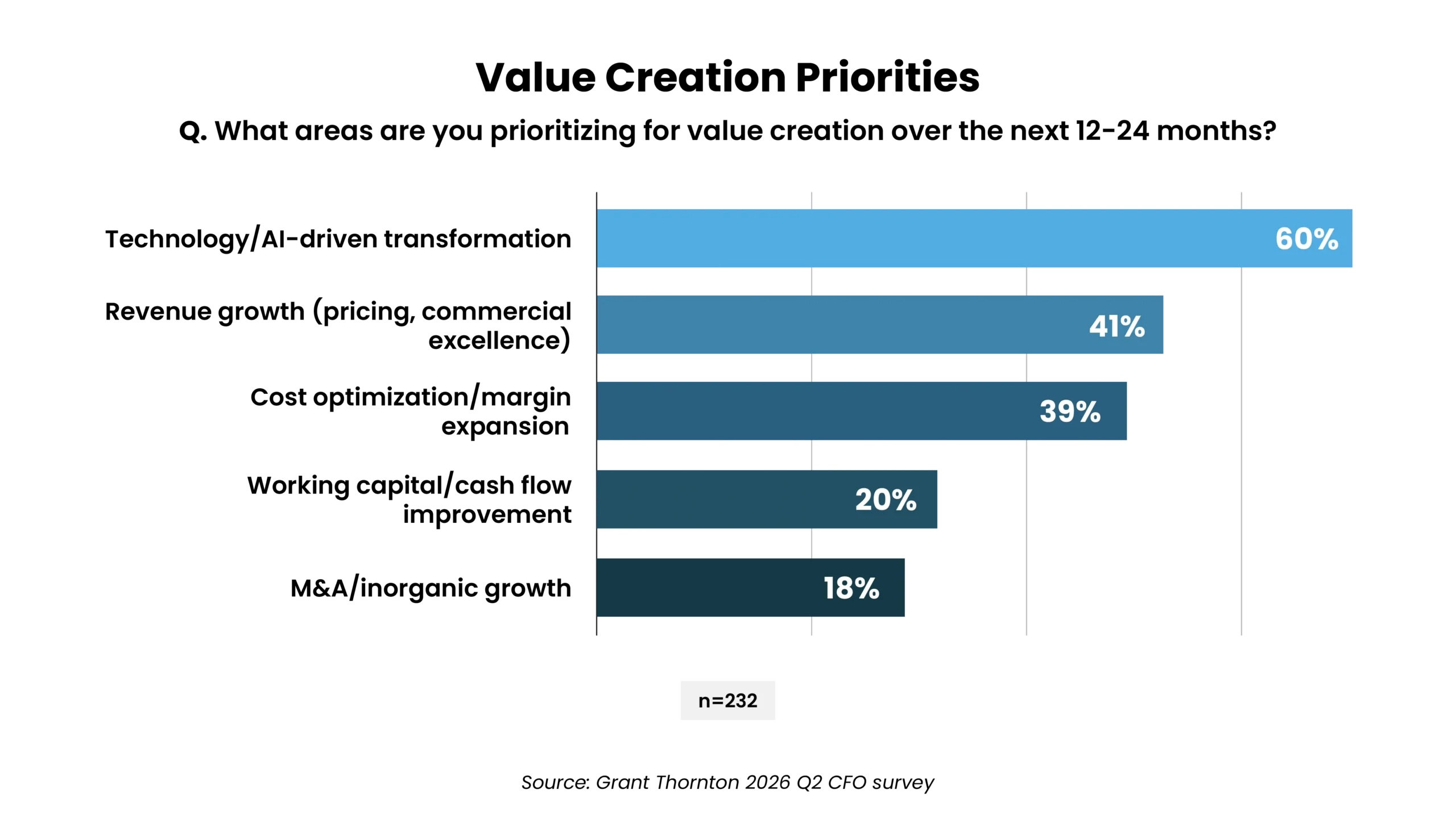
Technology and AI-driven transformation (60%) ranks as the biggest value creation priority for M&A buyers, followed by revenue growth (41%) and cost optimization (39%).
Yet many continue to struggle with execution.
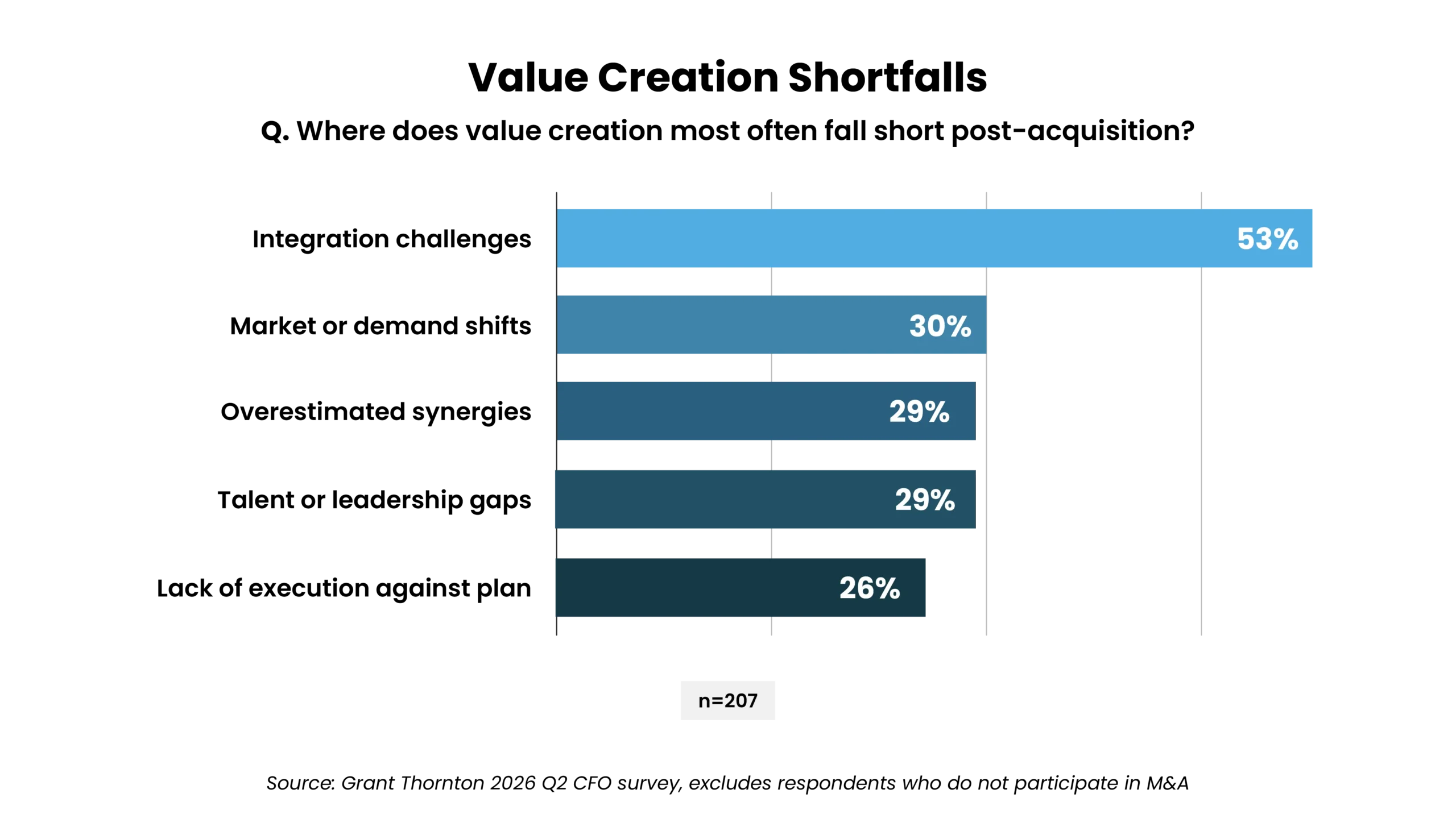
Integration challenges are the most common barrier to achieving post-deal objectives, cited by 53% of finance leaders. Overestimated synergies (29%) and talent or leadership gaps (29%) are also leading causes of post-M&A value creation shortfalls.
“The biggest challenge in M&A today is realizing value after the deal closes,” said Raul Vega, Auxis Grant Thornton Partner & CEO. “Organizations are being asked to deliver cost synergies, accelerate AI adoption, address talent shortages and improve business performance — all at the same time. The right outsourcing strategy provides access to the talent, capabilities and operational discipline required to translate strategic intent into operational results.”

“The biggest challenge in M&A today is realizing value after the deal closes.”
– Raul Vega,
Auxis Grant Thornton Partner & CEO
Value creation in M&A faces increasing headwinds
The pressure to execute is only intensifying.
Amid tariff uncertainty and higher oil prices driven by the outbreak of war in Iran, pessimism about the U.S. economy increased from 25% last quarter to 40% in Q2. As a result, cost optimization has surged as a business priority, with 87% of organizations now pursuing cost-reduction initiatives — up sharply from 72% in Q1.
Yet confidence in achieving key objectives remains limited, with 42% of CFOs confident about their ability to meet cost-control goals and 45% confident in their ability to achieve growth targets.
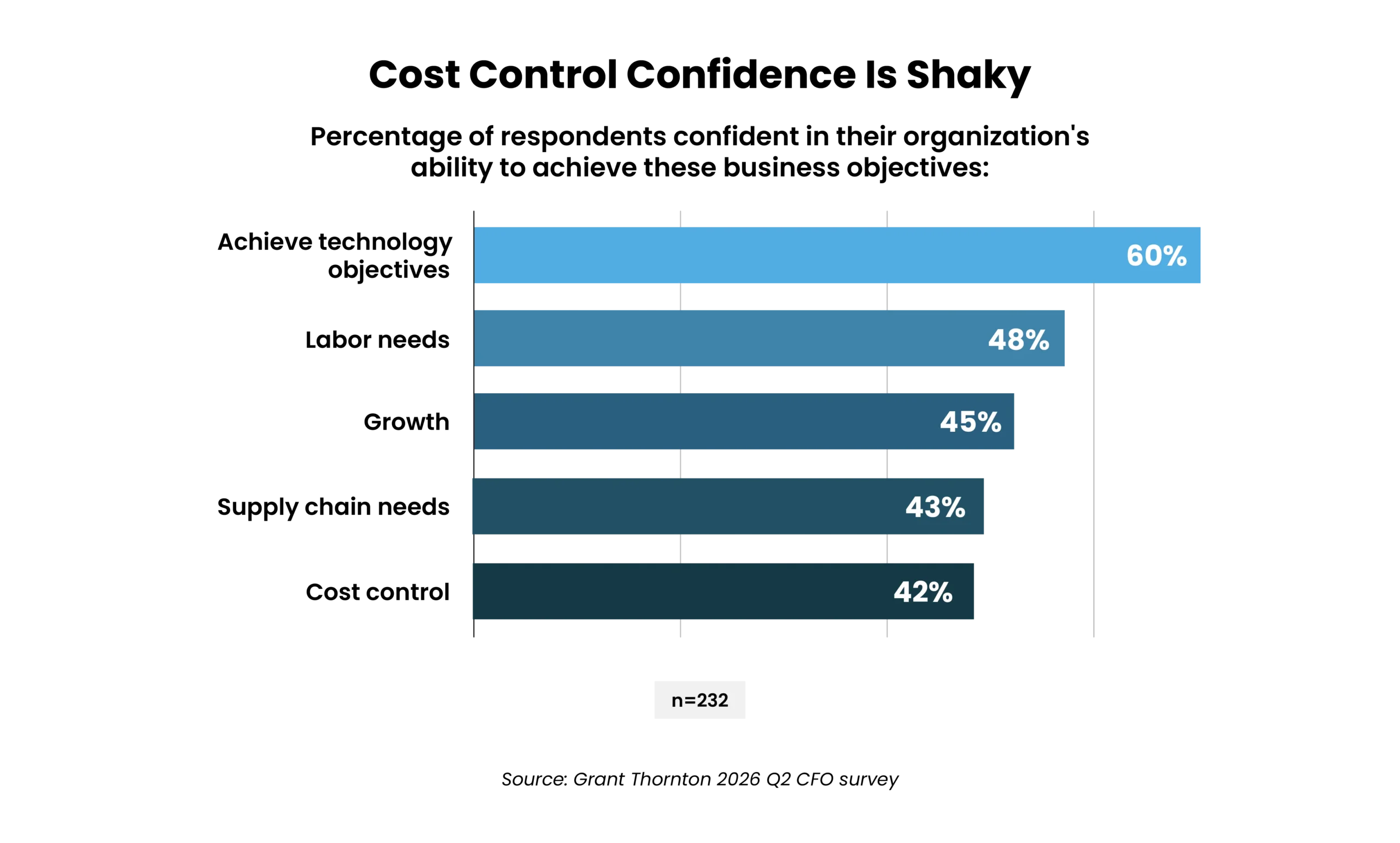
Talent constraints are further complicating M&A value creation efforts. Fifty-seven percent of CFOs expect continued challenges attracting and retaining talent, up from 54% in Q1, while fewer than half (48%) are confident in their ability to meet workforce needs.
At the same time, organizations continue to prioritize investment in cybersecurity and digital transformation, with 60% expecting increased cybersecurity expenses and 67% anticipating greater investment in IT and digital initiatives.

Taken together, these trends point to a widening gap between strategic objectives and an organization’s ability to deliver results.
Why does outsourcing drive M&A value creation?
Increasingly, buyers are turning to outsourcing to help bridge that gap.
Beyond traditional cost savings, outsourcing can accelerate integration timelines, provide access to specialized talent, standardize processes across acquired entities, and help organizations exit expensive Transition Service Agreements (TSAs) faster after carveouts. It can also provide the operational capacity needed to execute transformation initiatives and stand up independent operations without overburdening internal teams.
Outsourcing done right further helps organizations accelerate synergy realization by embedding AI and automation into newly acquired operations with AI-ready talent. It can reduce the cost and risk of transformation — leveraging operational efficiencies to help fund modernization initiatives while ensuring programs are governed effectively, measured against clear outcomes, and aligned with business value.
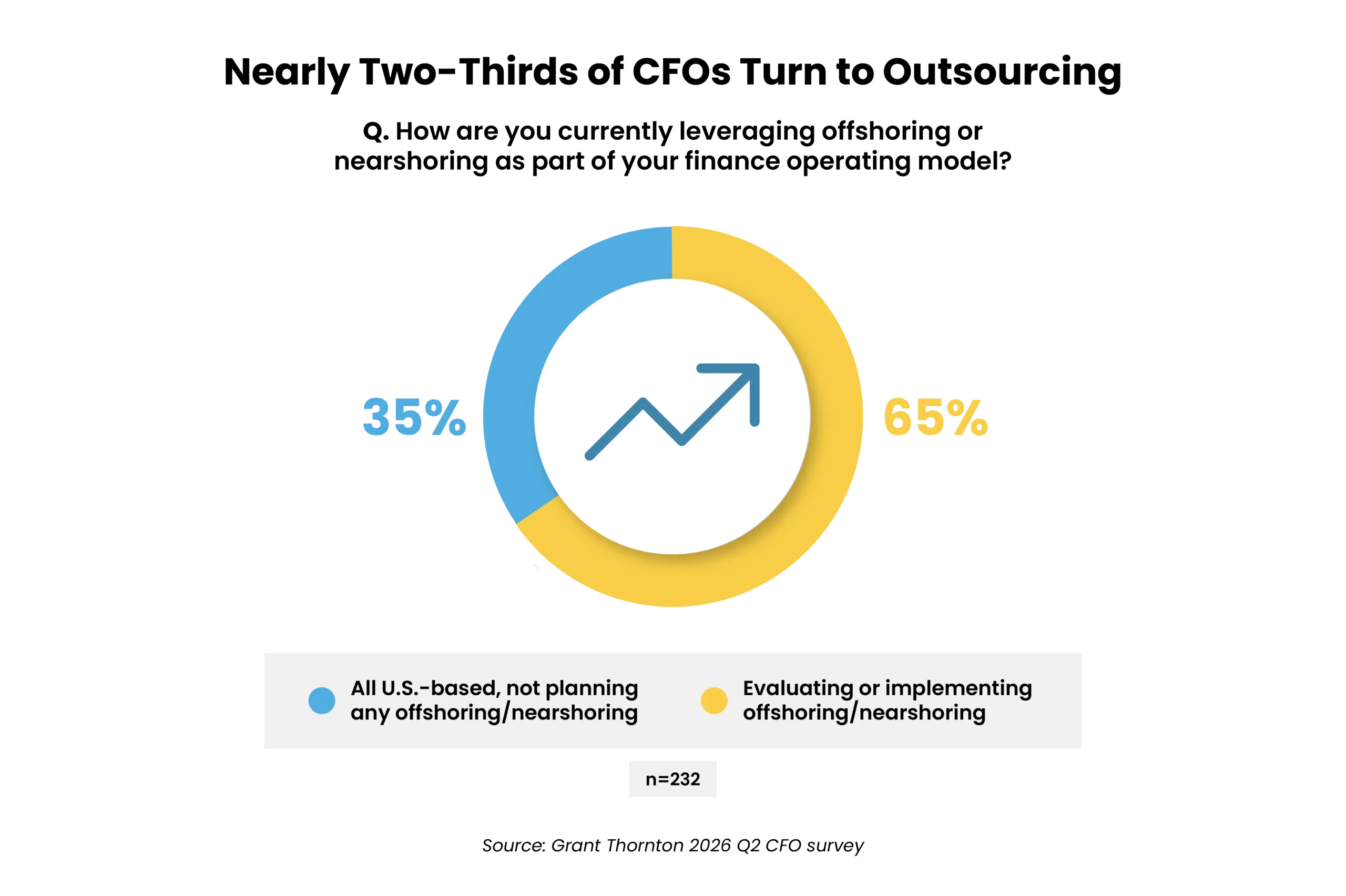
CFO survey results reflect this shift. Sixty-five percent of organizations are already implementing or evaluating offshore or nearshore delivery models, while only 35% plan to remain fully U.S.-based.
Nearshoring in Latin America continues to gain momentum, with 30% of finance leaders using nearshoring as part of their operating model — an increase of 11 percentage points from the previous quarter. Another 14% are actively evaluating nearshore delivery.
The growing popularity of nearshoring suggests organizations are increasingly prioritizing the skilled talent, agility, collaboration and cultural alignment needed to support complex work — alongside cost savings. Nearshoring delivers average labor arbitrage of 30% to 50% compared to U.S. operations.
Support for increasingly complex, end-to-end processes is especially valuable for midmarket organizations, which often operate with leaner finance, IT and operational teams than larger enterprises. Forty-three percent of midmarket ($100 million to $1 billion) finance leaders already maintain or are evaluating operations in Latin America. They are using nearshore delivery models to access specialized talent, increase execution capacity, accelerate modernization and support growth without adding significant fixed costs.
“The organizations gaining the greatest advantage from outsourcing are strengthening their ability to execute in addition to reducing costs,” said Keith Sayewitz, Auxis Grant Thornton Partner, Finance and Business Transformation & BPO. “By combining access to highly educated talent with real-time collaboration, strong AI capabilities, greater customization and close business alignment, nearshoring enables organizations to move faster, support increasingly complex work and achieve transformation and value creation objectives with less risk.”

“The organizations gaining the greatest advantage from outsourcing are strengthening their ability to execute in addition to reducing costs.”
Auxis Grant Thornton Partner,
Finance and Business Transformation & BPO
Value realization depends on effective execution
As organizations evaluate ways to accelerate value creation in mergers & acquisitions, the effectiveness of any outsourcing strategy depends on selecting a delivery model and partner aligned with their objectives.
Not every provider is built for the pace and complexity of private equity and M&A environments. Acquisitions and carveouts require a different approach than traditional outsourcing, demanding partners that can start small, prove value quickly, move faster, scale flexibly and adapt as priorities evolve.
Ultimately, as M&A activity increases, disciplined execution is becoming a greater differentiator than financial engineering alone.
“In today’s M&A environment, the organizations creating the most value aren’t necessarily the ones doing the most deals,” Sayewitz said. “Buyers that move the fastest to integrate operations, modernize processes and address capability gaps are the ones realizing the fastest payback and greatest return from their investments.”
Want to learn more about how outsourcing can accelerate M&A value creation? Contact our outsourcing experts today! Or, visit our resource center for more M&A tips, strategies, and success stories.
