


In brief:
- The latest IT outsourcing trends signal a shift in priorities as quality and outcomes surpass cost as the biggest drivers.
- IT outsourcing is emerging as a key enabler of AI adoption and stronger cybersecurity.
- 46% of businesses already outsource technology services, with 42% more considering outsourcing services over the next 12 months.
- Hybrid delivery models – anchored by nearshoring and enabled by AI – are emerging as the preferred operating structure as IT outsourcing evolves into a strategic, skills-driven partnership model.
As the scope and criticality of IT’s responsibilities within an enterprise grow, so do the challenges it faces. The latest IT outsourcing trends indicate how the model is growing and evolving in response.
Amid persistent talent gaps and increasing system complexity, cyberattacks, and operational demands, outsourcing of IT functions is undergoing a reset. What was once viewed as low-cost offshoring of non-strategic business processes is increasingly becoming a strategic, skills-driven, AI-enabled partnership model focused on proximity, flexibility, and measurable outcomes.
IT departments today spearhead AI and automation adoption, cybersecurity resilience, cloud scalability, and digital innovation – driving the enterprise’s innovation agenda and enabling long-term growth. At the same time, macroeconomic headwinds – from inflation to tariffs to regulatory expansion – have reinforced the need for cost discipline and operational resilience.
In this scenario, IT outsourcing is emerging as a critical lever for balancing innovation demands with cost discipline and access to in-demand skills.
Read on to explore the IT outsourcing trends emerging in 2026 – and what that means for operating models, talent strategy, and performance expectations. For a deeper dive, don’t miss our new report, 2026 IT Outsourcing Trends, which explores these emerging trends in detail and offers actionable insights for IT leaders.

1. IT outsourcing moves deeper into complex, mission-critical functions
Demand for IT services remains strong. The global IT outsourcing market is expected to hit $639 billion in 2026 – and rapidly expand by more than 17% to exceed $752 billion within five years, according to Mordor Intelligence. North America remains the largest supported market.
Demand signals are equally strong at the enterprise level. Some 46% of businesses outsource technology services, and another 42% are considering outsourcing services over the next 12 months, Wipfli’s latest Outsourcing Trends Report found.
This increased demand has been accompanied by a structural shift in how organizations source critical IT capabilities. While outsourcing traditionally focused on standardized, repeatable IT services such as help desk, desktop support, and infrastructure management, demand is now expanding toward more complex and critical IT functions, including:
- Cybersecurity
- Cloud operations
- AI-enabled infrastructure management
- Software development
- Hybrid architecture orchestration
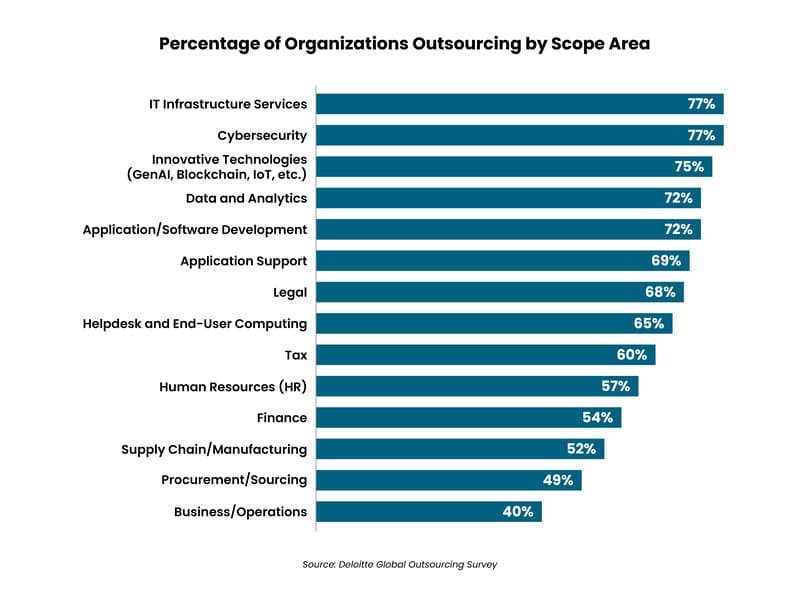
Notably, cybersecurity – ranking among the least-outsourced IT functions as recently as 2023 due to concerns around control and data privacy – now ties with infrastructure services as the most-outsourced business function across enterprises, according to Deloitte’s latest Global Outsourcing Survey.
So, what’s driving the shift?
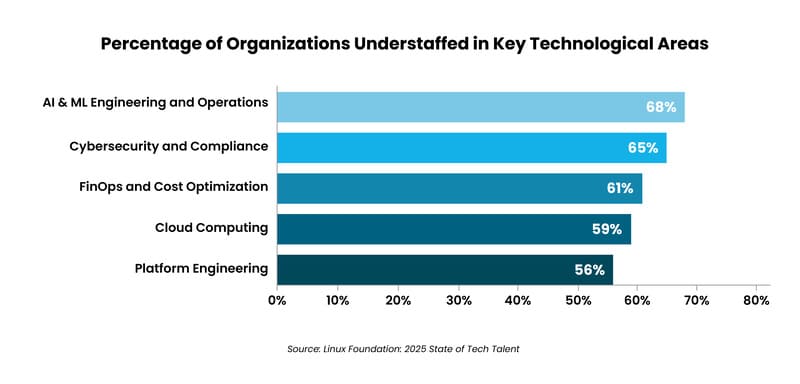
- Capability gaps in high-growth IT functions such as AI, cloud, and cybersecurity due to ongoing talent shortages, rising salary pressures, and escalating complexity. As a result, in-house teams also often lack the expertise or bandwidth to scale emerging technologies. Quality IT outsourcing service providers bridge that gap.
- Changing perception of IT outsourcing partners from vendors to strategic collaborators. Today, three out of four companies want their outsourcing partners to drive transformational outcomes such as new business models and technology innovation – not just cost savings, KPMG’s 2025 report, The Future of Outsourcing: Rethink Everything, found.
As a result, 81% of organizations are seeking IT outsourcing firms who can function as strategic collaborators – not just transactional service providers, the report states.
While cost savings remain a priority, IT leaders are increasingly measuring success through measurable outcomes, digital innovation, access to advanced tools, and reliable pools of experienced tech talent. - Provider maturity and growing adoption of outcome-based models, as leading IT outsourcing companies invest heavily in AI, automation, and cloud infrastructure. These, in turn, are enabling more advanced delivery models, such as AI-driven service desks, predictive cybersecurity operations, autonomous cloud optimization, and Agentic AI for infrastructure management.
As a result, top IT service providers are advancing from task-level automation to Generative and Agentic AI architectures that enable contextual decision-making, exception management, and end-to-end orchestration – delivering greater efficiency, resilience, and client value.
Today, nearly half (44%) of IT outsourcing contracts include AI and automation components, and more than half (54%) of firms adopt hybrid cloud outsourcing models.
Source: Global Growth Insights’ IT Services Outsourcing Market Analysis Report
Further, IDC’s FutureScape: Worldwide Services 2026 Predictions report expects that by 2029, 30% of IT service contracts will be outcome-based, emphasizing uptime, resolution times, and other performance metrics instead of tickets closed or labor hours.
2. Quality and outcomes overtake cost as the biggest IT outsourcing drivers
Outsourcing has long been a popular tactic to stretch dollars and close persistent talent gaps. But while cost still ranks among the top reasons for IT outsourcing, it is no longer the dominant driver.
Just 34% of organizations cited cost reduction as the primary factor for outsourcing on Deloitte’s latest outsourcing survey, down from 70% in 2020. Instead, organizations point to improved access to talent and a better ability to meet rising customer expectations as their biggest motivations.
KPMG’s report reinforces the increasing emphasis on factors beyond savings, with cost predictability prioritized more than cost savings. In today’s IT environment – defined by hybrid cloud architectures, escalating cybersecurity threats, and always-on digital operations – unexpected IT costs can disrupt revenue, compliance, and customer experience.
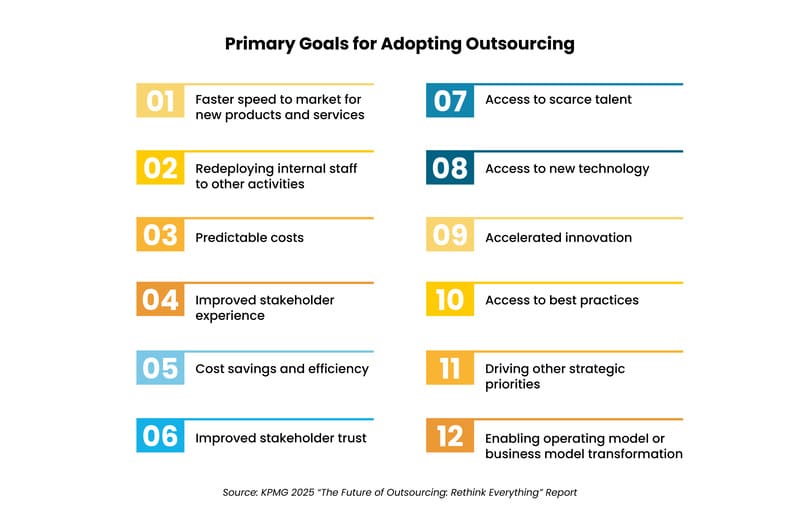
When asked about their primary outsourcing objectives, organizations ranked faster speed to market, the ability to redeploy in-house resources to more strategic activities, and predictable costs above cost savings on the KPMG survey.
Put simply, cost effectiveness has become table stakes. Competitive advantage, innovation, and business model transformation now define the value equation.
This longer-term, strategic orientation is reflected in satisfaction data. Wipfli found 93% of organizations that outsourced said they were satisfied with the experience.
The latest IT Outsourcing Statistics report by Computer Economics reinforces these findings. Across 11 functional areas, IT outsourcing achieved an average service experience success rate of 85%, with no area falling below 75% – underscoring consistent, quality performance across functions.
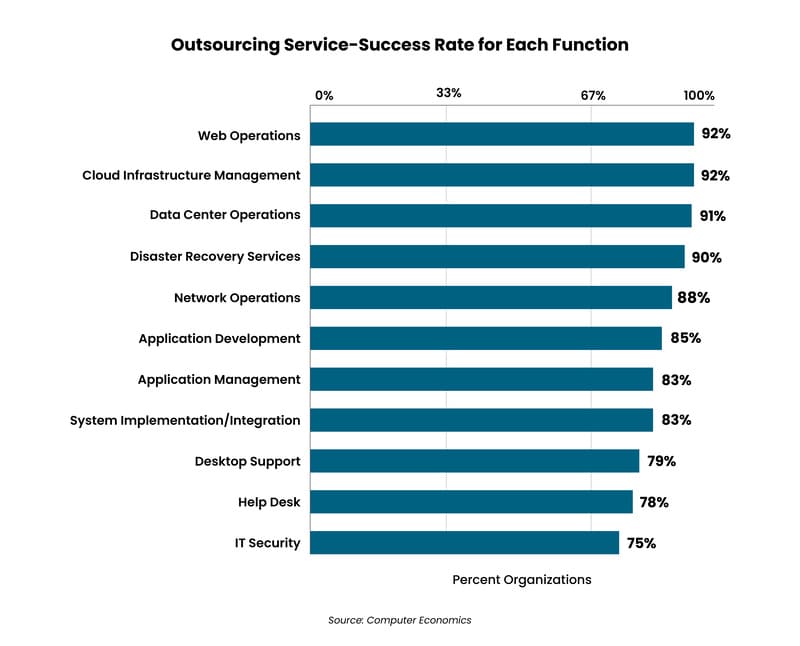
Similarly, the report showed high IT outsourcing success rates across these functions for lowering or maintaining costs:
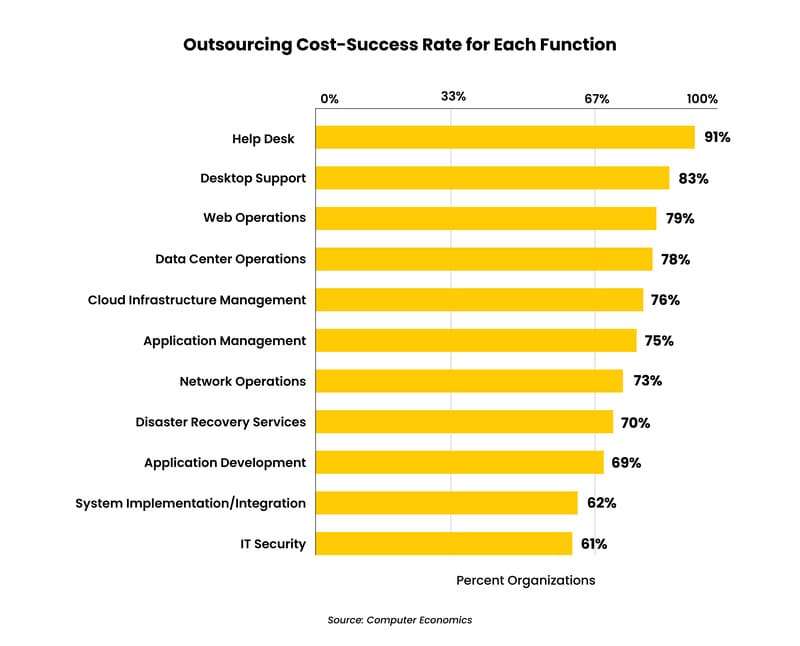
But here’s a noteworthy point: While help desk and desktop support scored the highest cost reduction success rates (91% and 83%, respectively), their service experience success rates were lower (78% and 79%).
While still strong, the disparity highlights a critical takeaway: choosing an experienced, high-quality IT outsourcing provider is essential – combining cost efficiencies with best practices, strategic advisory, strong performance management, a customer experience focus, and advanced technologies to maximize both savings and results.
3. AI redefines the IT outsourcing model
AI adoption has accelerated rapidly over the last few years, with global enterprise AI spending surging more than 200% year over year to $37 billion in 2025 (Menlo Ventures’ 2025 State of Generative AI in the Enterprise report).
By 2030, CIOs expect 75% of IT work to be performed by humans augmented with AI, and 25% by AI alone.
Source: 2025 Gartner CIO survey
AI is no longer experimental – it is becoming embedded into the core fabric of IT operations. But while investment has surged, results have not kept pace.
Only one-third of organizations report tangible financial benefits from AI in the past year (PwC’s 29th Global CEO Survey), and MIT’s State of AI in Business 2025 research suggests most enterprise AI programs still show zero return.
The challenge is no longer whether to experiment with AI – it is how to operationalize it at scale. That execution gap is fundamentally reshaping expectations for IT outsourcing partners.
From labor model to intelligence model
AI is rapidly shifting the IT outsourcing market’s value proposition beyond labor arbitrage and task execution. Instead, IT outsourcing is becoming a technology accelerator, merging advanced AI capabilities with experienced talent to deliver smarter execution, scalable performance, and maximized results across distributed delivery environments.
Providers are also embedding AI directly into delivery contracts, redefining SLAs around performance, availability, and intelligent automation rather than traditional measures like ticket volume.
Some 87% of IT leaders say they are leveraging outsourcing models to accelerate AI adoption and ROI – the highest of any core business function. They’re focused on gaining instant access to tools, capabilities, and expertise they can’t build fast enough in-house (Deloitte Global Outsourcing Survey).
AI-enabled delivery in practice
AIOps – the practice of applying AI, predictive analytics, and other technologies to automate and improve IT operations – is emerging as one of the clearest examples of this shift. By applying AI to IT operations, outsourcing providers are helping to:
- Reduce downtime through early anomaly detection and faster root-cause analysis
- Accelerate incident response, improving service reliability and user experience
- Automate routine operational tasks such as alert triage, remediation, and capacity planning
- Enhance visibility and intelligent insights across complex hybrid, multi-cloud computing, and distributed systems
- Proactively identify service risks to support consistent application performance and better digital experiences for employees and customers
- Improve forecasting, performance optimization, and infrastructure planning aligned with real-time business demand
Beyond operational improvements, the financial impact can be substantial. BCG’s latest IT Spending Pulse projects GenAI could reduce addressable IT costs by up to 50% through efficiency gains and intelligent automation of knowledge work.
Closing emerging technology gaps
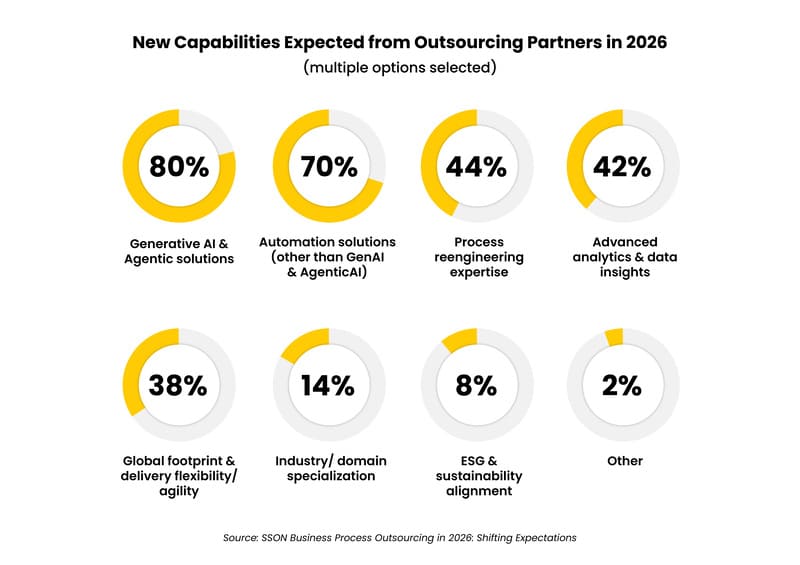
Bridging technology execution gaps is the top expectation organizations are placing on outsourcing partners in 2026, with Generative and Agentic AI capabilities leading the agenda (SSON Business Process Outsourcing in 2026: Shifting Expectations report).
As performance expectations rise, enterprises increasingly expect IT outsourcing partners to deliver ready-to-deploy AI capabilities and proven use cases that drive measurable operational improvement.
One example: Auxis is embedding GenAI-powered voice agents into enterprise service desks as Level 0 support – handling first-contact interactions 24x7x365 and resolving routine issues autonomously. Powered by advanced natural language understanding and contextual reasoning, these systems minimize call abandonment, accelerate resolution, and elevate user experience while reducing dependency on human intervention.
Agentic AI marks the next stage of this evolution – moving IT outsourcing beyond task automation toward intelligent, coordinated execution at scale. More than half of businesses deploying or planning to deploy AI agents are prioritizing IT and cybersecurity use cases (PwC 2025 AI Agent Survey). Early adopters are already reporting operational cost reductions of up to 38% (2026 Automatic.co report).
But as IT teams overwhelmed with competing priorities struggle to keep pace with the speed of new technologies, they are increasingly turning to outsourcing partners to embed advanced capabilities into operations.
AI governance as a differentiator
As AI expands, so do regulatory and compliance risks. Yet fewer than half of technology leaders have formal AI governance frameworks in place, a 2025 Collibra survey found. Only 47% provide governance or compliance training for employees.
It’s a dangerous gap: Among organizations that reported AI-related breaches, 97% lacked proper AI access controls and governance, according to IBM’s 2025 Cost of a Data Breach Report found.
Leading IT outsourcing providers are differentiating by building governance frameworks directly into AI-enabled delivery, including AI model oversight, data protection, risk controls embedded into automated workflows, and transparent reporting and auditability.
Get the “2026 IT Outsourcing Trends” report
Learn the other critical IT outsourcing trends shaping the outsourcing market in 2026 – and dig deeper into the ones above. You’ll also discover what organizations can do now to translate today’s emerging IT outsourcing trends into smarter strategy, stronger governance, and reduced risk.
Download our 2026 IT Outsourcing Trends report to learn:
- Why IT outsourcing is expanding into higher-value, mission-critical work
- Why cost efficiency is now a baseline expectation – not the primary outsourcing driver
- How AI is reshaping outsourcing models and redefining performance expectations
- Why cybersecurity is now the #1 outsourced business function
- Why more companies are increasingly favoring nearshore and hybrid delivery models
Want to learn more about how nearshore IT outsourcing can support your business needs? Schedule a consultation with our leaders today! Or visit our resource center to learn more IT outsourcing trends, strategies, and success stories.
Frequently Asked Questions
Based on leading IT outsourcing industry trends in 2026, which IT functions are most outsourced today?
How is AI influencing IT services outsourcing trends?
Why are more enterprises outsourcing mission-critical IT functions?
What should enterprises look for in a modern IT outsourcing provider?
Why are trends in IT outsourcing pointing to a shift from offshore to nearshore or hybrid delivery models?
